
Your AI pilot works. The team that tested it doesn’t want to give it back. Then your CFO asks for the AI ROI before anyone funds production. What will it return, and how soon will it pay for itself? Your provider’s case study won’t answer that, and a one-line formula with made-up numbers won’t survive the first follow-up question.
The usual formula leaves out the costs that arrive after launch: the model bill, quality monitoring, human review, and retraining when accuracy slips. At LaunchPad Lab, we see those costs from the build side, because we design and run AI inside working software.
Here’s how to get what your CFO asked for: a low case, a payback date, and a way to check both after launch.
TL;DR
- AI ROI is net benefit divided by total cost of ownership (TCO), which includes running and maintaining the system.
- Measure the manual process for a few weeks before the build.
- Count three cost layers: the build, the run (model usage, hosting, human review), and upkeep (monitoring, retraining, updates).
- Build a low, expected, and high case, and agree with finance on the result the low case must hit.
- After launch, check projected results against a control group.
What is AI ROI? The formula, and the cost you shouldn’t leave out
AI ROI is the net benefit an AI system produces over a set period, divided by its total cost of ownership over the same period. Net benefit is what the system returns once you take away its own costs. Total cost of ownership is where calculations usually go wrong. Many count only the build, but the system also has to run and stay accurate the whole time.
ROI (%) = (total benefits minus total costs) / total costs x 100
The bottom half of that formula is where the money hides. In the worked example below, two years of running costs add up to more than the build.
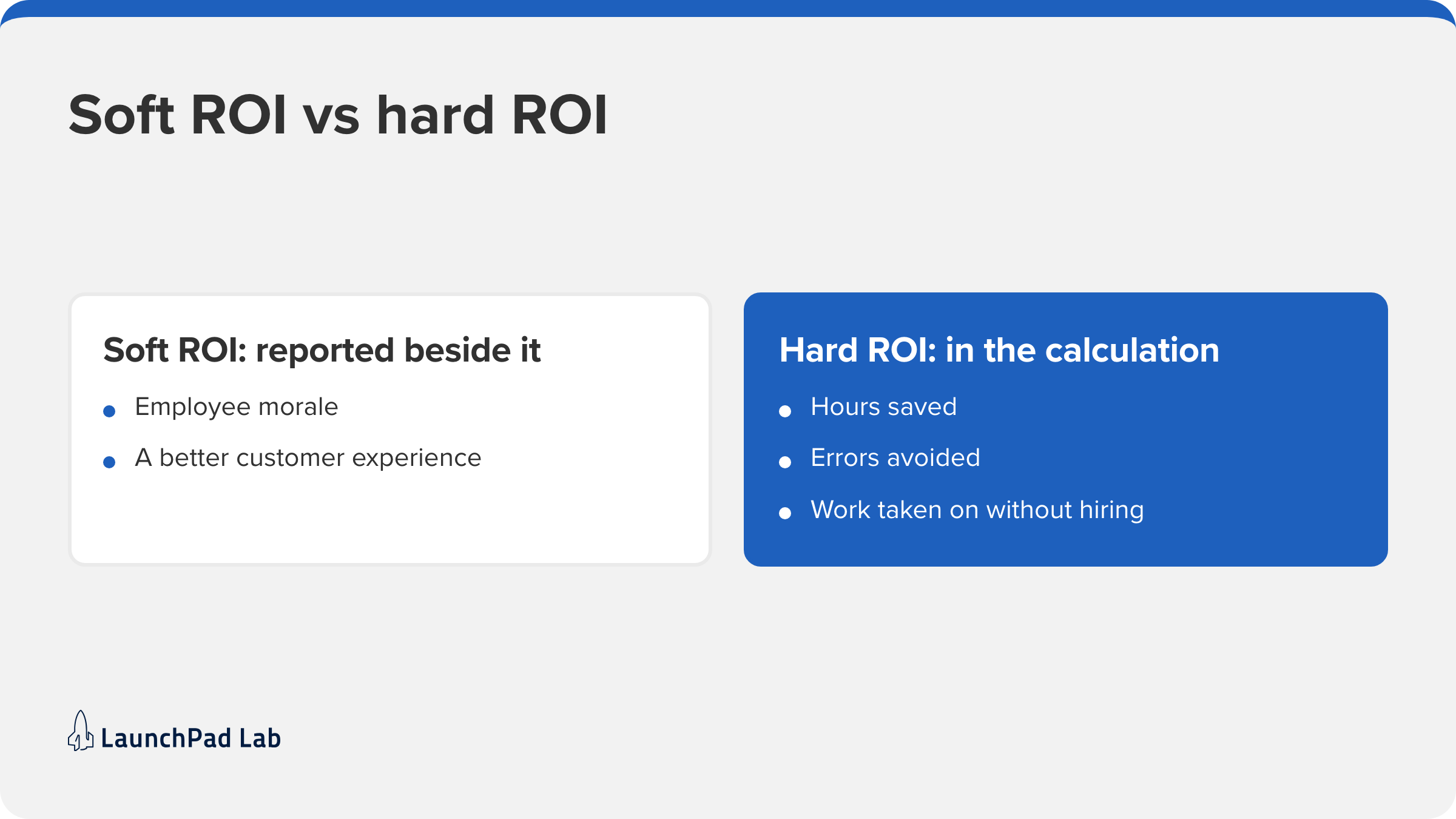
The top half, total benefits, raises a different question: which benefits should count? They come in two kinds. Hard ROI is the return you can tie directly to profit, such as hours saved, errors avoided, and work you can take on without hiring. Soft ROI covers real gains that don’t reach profit right away, such as employee morale or a better customer experience.
How to measure AI ROI in 4 steps, before you build
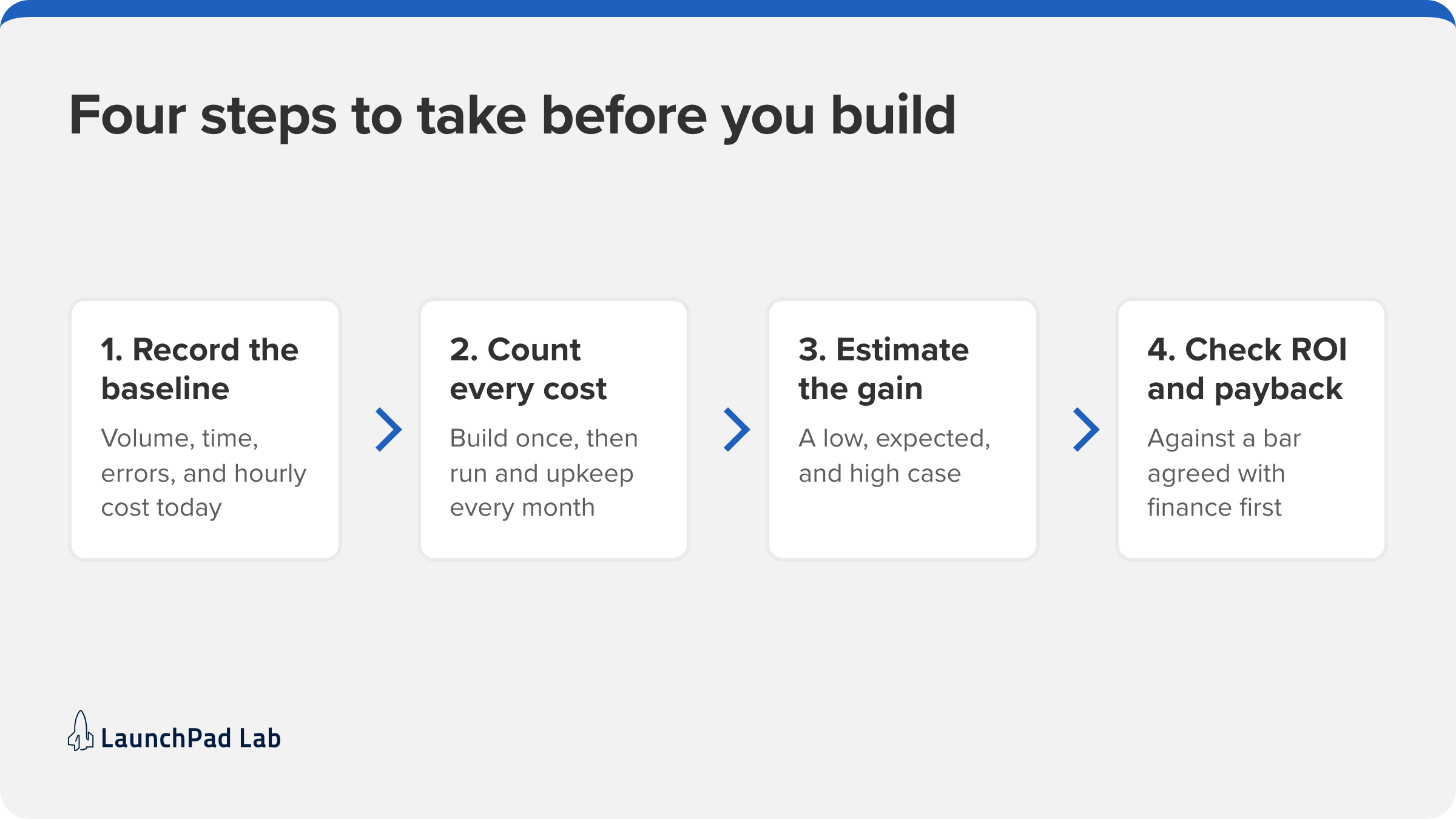
The formula is simple, but filling it in with numbers your CFO will trust is the hard part. Good AI ROI measurement starts weeks before the build, because once the new system is live, the old process is gone and you can’t measure it anymore.
1. Write down how the work gets done today
Every benefit in your case is a comparison with today, so start there. Watch it run for a few weeks, with the people who do the work. The processes worth automating are usually the ones you can measure this way, which is where our AI automation services come in. These are the four numbers to write down:
- Volume: how many items come in per week or month.
- Time per item: how long one item takes from start to finish.
- Error or rework rate: how often finished work comes back.
- Fully loaded cost: what the people doing it cost per hour, with benefits and overhead.
2. Count the hidden costs of AI that arrive after launch
Next comes the bottom half of the formula. Many estimates stop at the build, but the costs they leave out arrive after launch and keep arriving every month. Here’s when each layer shows up:
| Cost layer | What it includes | When it shows up |
| Build | Design, engineering, integration with your systems, data preparation | Once, before launch |
| Run | Inference (each model call, billed per token on most model APIs), hosting, human review of outputs | Every month, rising with volume |
| Upkeep: monitoring | Evaluation sets, quality monitoring, alerting | Every month from launch |
| Upkeep: changes | Prompt and model updates, retraining when quality drifts, integration changes, change management and training | For the life of the system |
3. Estimate what you’ll gain, from worst case to best
Now for the top half of the formula (the benefits). Start from your step 1 numbers and price what changes: hours saved times the hourly cost, errors avoided times what each fix costs, and extra work the team can take on without hiring.
Then build three cases by changing the two assumptions you’re least sure of: how much time the AI saves per item, and how many people use it. Adoption usually moves the range the most, because a tool used by half the team returns half the hours.
Adoption has a cost, too: change management, the training and process changes that get people using the tool. Budget for it in the upkeep layer.
4. Work out the ROI and when it pays for itself
With costs and benefits in hand, run the ROI formula on each case. Then work out the payback period, the number of months it takes for net benefit to cover the build cost.
To get it, subtract annual run and upkeep costs from annual benefit, divide the build cost by the result, and multiply by 12. For multi-year cases, use net present value (NPV), which counts a dollar saved in year three as worth less than one saved today.
What the math looks like on a real AI build
Here are those four steps on a build like one we shipped for an actuarial consulting firm with over 100 experts producing valuation reports by hand. We built them a custom application with AI-driven parsing, and the firm projects a “$2M Projected Annual Profit Increase.” Apart from that projection, the figures below are illustrative assumptions, not what this build cost and not our exact pricing.
Where the firm started: reports that took up to 60 days
Before the build, reports took up to 60 days to complete. Actuaries spent that time keying in data, reconciling files, and trading emails and spreadsheets with clients. That’s what the new system has to beat.
For the benefit range in step 3, we’ll use the firm’s projection as the high case and assume slower adoption for the other two:
- Low case: $1,000,000 a year, if only half the team moves to the new workflow in year one.
- Expected case: $1,500,000 a year, with adoption still ramping up.
- High case: $2,000,000 a year, the firm’s full projection.
What it costs to build it and keep it running
Step 2 puts a figure on each cost layer.
- Build: $500,000, paid once.
- Run: $180,000 a year for model usage, hosting, and the actuary time spent checking parsed data.
- Upkeep, monitoring: $60,000 a year for evaluation and quality monitoring.
- Upkeep, changes: $110,000 a year, mostly change management and training in year one, then model updates and retraining.
Year one comes to $850,000. Year two comes to $350,000, even though there’s nothing left to build. That’s 70% of the build cost, and a calculation that only counts the build would miss every dollar of it.
Does it clear the bar?
Step 4 checks ROI and payback against a bar finance agreed on before the build: in the low case, the system must pay back the build within 12 months of going live. Low-case ROI for year one works out to ($1,000,000 minus $850,000) / $850,000 x 100, or 18%. Counting from launch, the three cases compare like this:
- Low: 18% year-one ROI, payback in about 9 months.
- Expected: 76% year-one ROI, payback in about 5 months.
- High: 135% year-one ROI, payback in under 4 months.
The low case clears the bar, so the build is a go.
The model, the number of calls per file, and how much human review stays in the loop are all decided during the build. Getting those choices right is a large part of our AI software development work, because they decide what the system costs to run for years.
How to build a business case for AI your CFO will sign
The worked example above is most of your business case already. A business case for AI puts the same numbers in front of the person who signs off. Expect two questions first: what’s the low case, and when does it pay back? For the actuarial build, the first page would show an 18% low-case ROI and payback in about 9 months, against a 12-month bar.
What is a good AI ROI? It depends on the bar you set
There’s no single good number. A good AI ROI clears the bar you set before the build in the low case, pays back within a period your finance team accepts, and beats the next-best use of the same budget. Is a 75% ROI good? Over one year, usually. Spread over five years, a 75% return works out to about 12% a year, which may not beat your cost of capital, the return your company could earn by putting that money elsewhere.
What changes when the pilot becomes the real thing
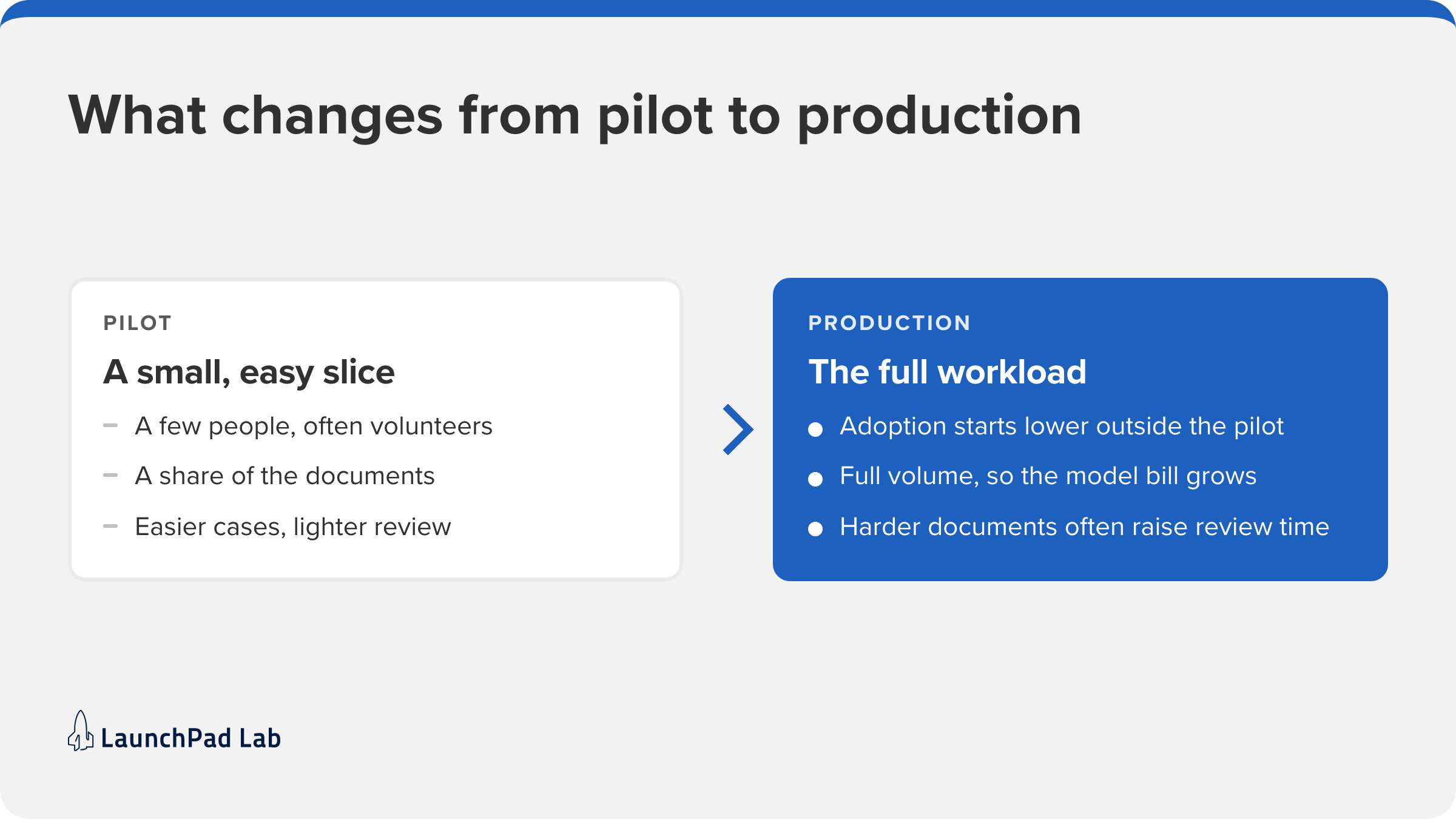
The numbers in a business case usually come from a pilot, and a pilot is measured on a small, easy slice of the work. A few people, often volunteers, try the tool on a share of the documents. The results are real, but they’re small.
Before you scale, rerun the business case with what the pilot measured, such as time per item, model cost per item, and weekly users, scaled up to your full volume. Expect review time per item to rise, because the full workload often includes harder documents than the pilot did. Expect adoption to start lower outside the pilot group, too. Agree on the production bar with finance before the pilot ends, so a promising result doesn’t quietly lower the standard.
If you’re still choosing which process to pilot, start with our guide to practical AI use cases for business.
After launch, check the number against what really happened
Once the system is live, your business case becomes a forecast you can test. Knowing how to measure AI ROI after go-live matters as much as before. In the first 90 days, three habits turn a projected number into a realized one:
- Keep measuring the baseline metrics. Record the same four numbers, the same way you did before the build.
- Compare against a control group. A team or region still working the old way lets you separate the AI’s effect from seasonality or new hires.
- Track running costs as actual invoices. Put each month’s model, hosting, and review bills next to the estimate.
Set your AI ROI bar before the next build
An AI ROI figure that holds up in front of finance gets built the same way every time. Measure the process before it changes. Count the build, the run, and the upkeep, including the model bills and retraining that arrive after launch. Estimate the benefit as a range, and agree on the bar with finance before anyone writes code.
Building a business case for AI is the first piece of work in any AI build we scope. It’s the purpose of our AI consulting engagement, where we help you discover where AI will pay back and what it will cost to run. If you have a pilot waiting on a budget decision, we’d be glad to work through the numbers with you.
Build your AI business case with us
Frequently asked questions
Is AI actually turning a profit?
For many companies, not yet as planned. In the IBM Institute for Business Value’s 2025 survey of 2,000 CEOs, CEOs reported: “only 25% of AI initiatives have delivered expected ROI over the last few years, and only 16% have scaled enterprise-wide” (IBM).
What is the ROI of agentic AI?
The ROI formula is the same, but the running costs are heavier. An AI agent plans and takes actions, so it often makes several model calls per task and needs evaluation and human review. Measure the benefit per completed task against a go/no-go bar such as 12-month payback. Our guide to building AI agents covers the design side.
How long does it take to see ROI from AI?
As long as the payback period in your own business case. Industry averages mix very different projects. A high-volume process with a measured baseline can pay back within 12 months, while one that few people adopt may never pay back.