
Your nurses are working through a backlog of faxed records, prior authorizations are stacking up, and claims sit while staff chase missing documents. Every vendor you talk to says an AI agent will take care of it, and some of them may be right. What you need to know is which part of the work you’d trust an agent with, and what happens to a patient or a claim when something goes wrong.
That comes down to where an agent can do the work and where a person has to make the call. At LaunchPad Lab, we build AI agents for healthcare teams to help them make decisions and act faster, and we’ve seen that the answer changes from one workflow to the next.
Below, we’ll show you how to pick one workflow, decide how far an agent can go before a person steps in, and check what has to be in place before it touches patient records.
TL;DR
- Start AI agents in healthcare with administrative work that has a document backlog, like claim review. Keep diagnosis and treatment with clinicians.
- Set autonomy by risk: ask what a wrong answer does to a patient and whether the action can be undone.
- Most healthcare work belongs at autonomy levels 1 and 2 today: the agent suggests, or drafts, and a person decides.
- Give the agent read-only electronic health records (EHR) access first, and sign a business associate agreement (BAA) with every vendor that touches protected health information (PHI).
- Run it in shadow mode against real cases, then move up a level only when the numbers hold.
What are AI agents in healthcare?
AI agents in healthcare are software that takes a goal, like assembling a prior authorization request, and works through the steps across your clinical and administrative systems.
The agent pulls what it needs from the EHR and payer portals, plans the next step, uses tools to act, and checks the result before moving on. A person still reviews anything that carries clinical or financial risk, and deciding how much the agent does before that review is the real design choice. If you want the basics first, we explain what an AI agent is in a separate post.
How an AI agent differs from a chatbot or an RPA bot
A chatbot answers questions, such as explaining the charges on a patient’s bill. A robotic process automation (RPA) bot follows a fixed script, like copying claim data into a payer form the same way every time, and it breaks when the form changes. An AI agent decides what to do next. Given a denied claim, it reads the denial reason, corrects the codes, resubmits, and hands the case to a person if the second attempt fails. If your work follows the same steps every time, RPA may be all you need. When it calls for judgment across systems, that’s when it’s worth scoping an agent build.
What is the difference between agentic AI and AI agents?
Agentic AI in healthcare describes a capability: pursuing a goal across several steps with some independence. An AI agent is the system that has it. People use the two terms interchangeably, and when you’re buying, the difference rarely matters, because what you evaluate is the agent. We go deeper on agentic AI on our blog.
Which healthcare workflows can AI agents run today?
Here are seven common agentic AI use cases in healthcare, along with what the agent does, where a person signs off, and which systems it touches.
| Workflow | What the agent does | Where a human signs off | Systems it touches |
| Clinical documentation | Drafts the visit note from the encounter | Clinician reviews and signs every note | EHR, encounter transcript |
| Patient intake and scheduling | Collects forms, checks insurance details, proposes appointment slots | Staff handle exceptions and anything clinical | Patient portal, scheduling system, EHR |
| Prior authorization | Assembles the clinical evidence and submits the request | Clinician or reviewer approves any medical necessity call | EHR, payer portals, documents |
| Claim and utilization review | Extracts case data, matches guidelines, drafts a recommendation | Nurse reviews every draft | EHR, claims system, guideline library |
| Revenue cycle management | Checks eligibility, suggests codes, corrects and resubmits denials | Coder or billing lead approves code changes | Billing system, clearinghouse, payer systems |
| Care coordination and follow-up outreach | Drafts follow-up messages, tracks open referrals | Care manager approves messages with clinical content | EHR, messaging, referral tracking |
| Diagnostic decision support | Surfaces possible diagnoses with supporting evidence | Clinician makes every decision | EHR, imaging, lab systems |
Agents are doing real work today in the administrative rows, while the diagnostic row is further behind. A PLOS One scoping review of 43 studies found that evaluation settings were “predominantly simulated environments or laboratory studies,” with few clinical pilots or real-world deployments. Use-case lists can make all seven rows look equally ready, but the research doesn’t back that up.
In the healthcare builds we’ve scoped, the first workflow worth automating is usually the one with the largest document backlog, not the most clinical one. Reading faxed and handwritten records takes up nurses’ time, and an agent can prepare that work without making a clinical call. To see how these steps fit together in a real workflow, take a look at AI agent workflows.
Decide how much an agent may do before a human signs off
You’ll hear the phrase supervised autonomy a lot: the agent does the work, and a person stays accountable for the outcome. It’s a useful starting point, but it doesn’t tell you how much supervision a given workflow needs. The three steps below help you decide.
1. Score each workflow on clinical risk and reversibility
Ask two questions about each workflow. What happens to a patient if the agent is wrong? And can the action be undone before it reaches the patient or the payer? A scheduling reminder with the wrong time is low risk and easy to fix, so the agent can go further on its own. A medication change is high risk and can’t be pulled back once it’s made, so the agent shouldn’t touch it. Write the answers down for each workflow before you pick a level.
2. Match the workflow to one of four autonomy levels
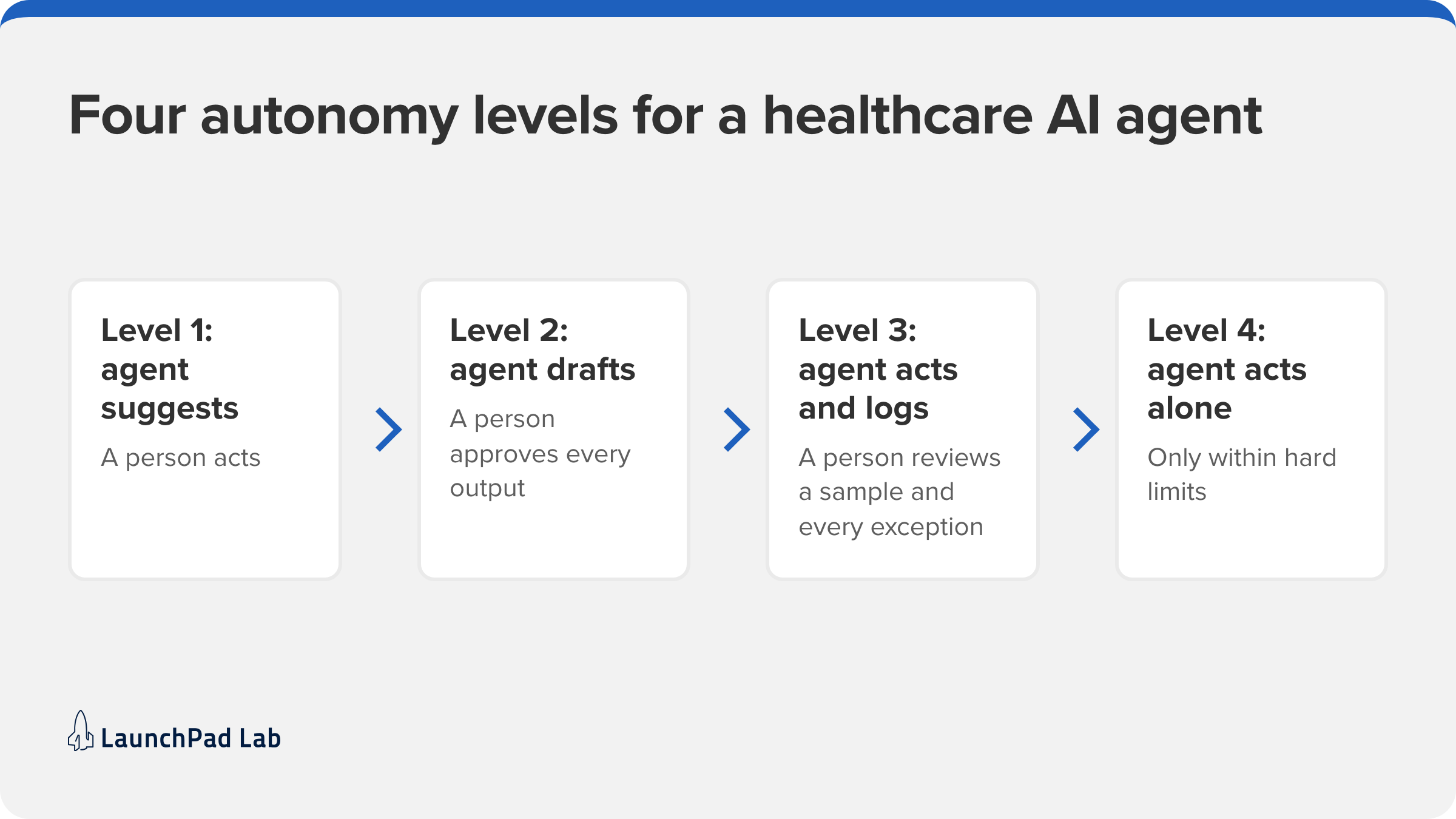
Pick the level that fits the risk:
- The agent suggests; a person acts.
- The agent drafts; a person approves every output.
- The agent acts and logs; a person reviews a sample and every exception.
- The agent acts alone within hard limits.
Most healthcare work belongs at levels 1 and 2 today, and clinical decisions stay with clinicians. A framework in Cell Reports Medicine describes a similar progression, from no AI involvement through assistant and active collaborator to full autonomy.
3. Design the review step so reviewers don’t rubber-stamp
The risk at level 2 is a reviewer who clicks approve on everything, so build the review step to prevent that.
- Show the evidence next to the recommendation.
- Make the reviewer confirm the key field, such as the diagnosis code or the guideline matched.
- Send low-confidence cases to a person before the agent drafts anything.
- Track how often reviewers change the agent’s output, because a rate near zero deserves a closer look.
In our claim review build, no determination is final until a nurse has reviewed the draft, which is level 2 by design.
Worked example: a claim review agent with a nurse in the loop
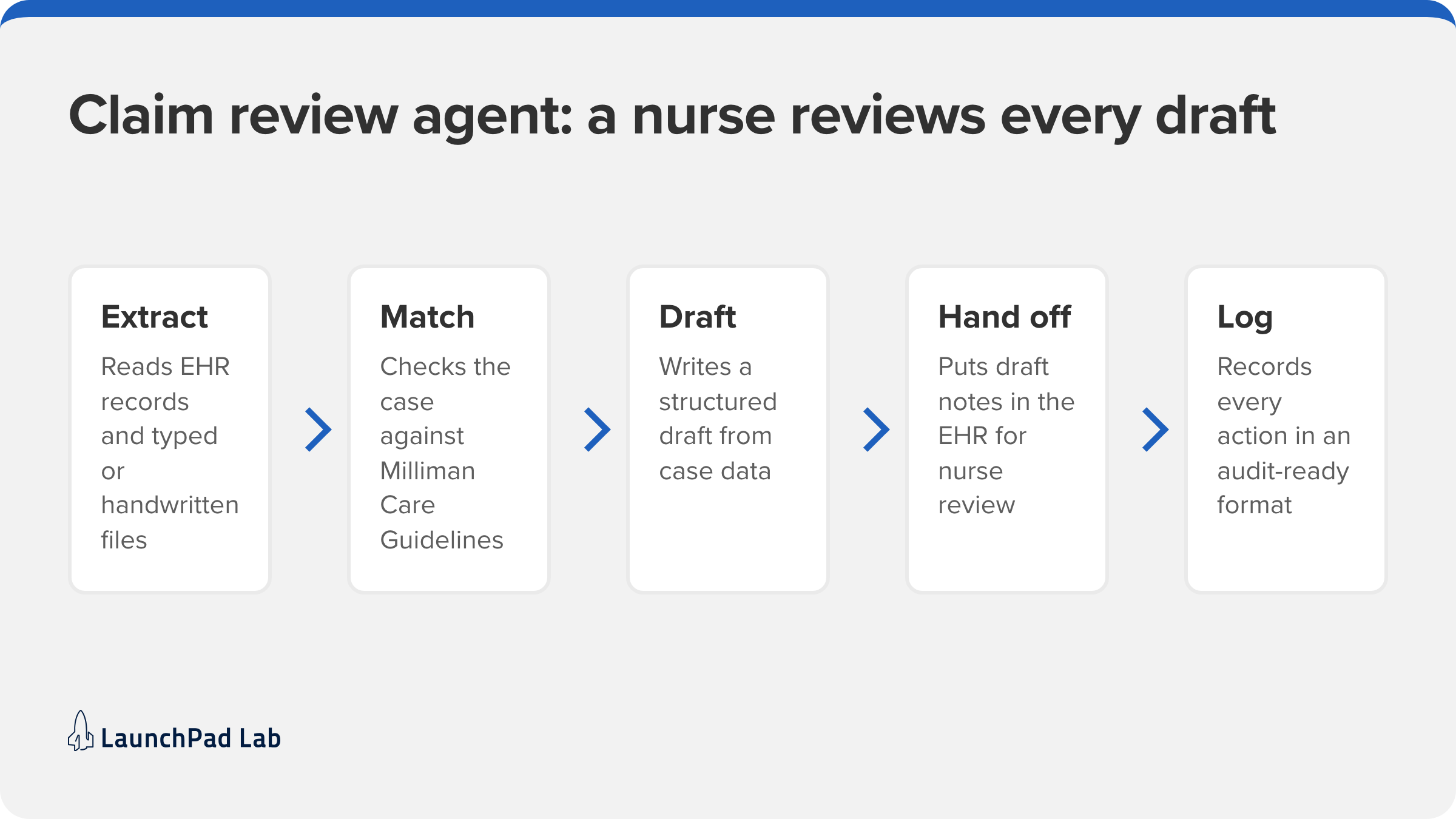
Here’s what level 2 looks like in a project we shipped. A healthcare insurance technology platform that supports self-insured employers, third-party administrators, and health insurers needed faster, more consistent clinical claim review. Nurses were reading faxed, typed, and handwritten records one by one while case volume climbed. We started with a Blueprint Workshop with clinical, compliance, and IT stakeholders, then built an agent that works in five steps:
- Extract. The agent reads EHR records and unstructured documents, including typed and handwritten content, and pulls the patient details and the provider’s request.
- Match. It compares each case against Milliman Care Guidelines to assess medical necessity.
- Draft. It produces a structured recommendation from standardized workflows and case data.
- Hand off. It writes structured draft notes into the EHR for a nurse to review.
- Log. It records every action in an audit-ready format.
The case study reports an expected reduction in clinical review turnaround from 3–4 days to under 24 hours, and an 85–90% accuracy rating for the AI’s determinations. Guideline-aligned outputs also reduced variation across reviewers. The build centered on document processing, which is often where healthcare teams see the first payoff from our AI automation services.
Connect the agent to your EHR with read access first
Integration is easy to overlook, and the research names it as a challenge. The Cell Reports Medicine paper notes that “legacy hospital systems often lack standardized APIs and interoperability standards.”
Many EHRs now expose data through Fast Healthcare Interoperability Resources (FHIR), the HL7 standard for exchanging health information as structured resources. Authorization usually runs through SMART App Launch, which limits an app to the resource types and operations its scopes allow.
The rule to follow: grant read access first, write-back last, and only for the fields the agent’s autonomy level allows.
At level 1, the agent only reads. At level 2, it can write a draft into a field marked for review. Security leaders quoted by Axios in October 2026 warn that an agent with broad access to records, billing, and communications can change things nobody meant it to touch.
On our builds, integration starts in the first sprints, with a system inventory, field mapping, and sandbox testing before production. If you want to see how the pieces connect, the AI agent architecture post walks through it, and the healthcare work we do shows where integration tends to decide the outcome.
What makes a healthcare AI agent HIPAA compliant?
No agent is HIPAA compliant by itself. Compliance comes from the agreements, access controls, and logging around it, and there’s no official HIPAA certification for software you can point to. Building HIPAA-compliant AI agents for healthcare is as much about vendors and process as it is about technology. Here’s how you can make your healthcare AI agent HIPAA compliant, plus one more check to run before launch:
Sign a BAA with every vendor that touches PHI
HHS says a cloud service provider (CSP) that creates, receives, maintains, or transmits electronic PHI (ePHI) for you is a business associate, “even if the CSP processes or stores only encrypted ePHI” (HHS, Guidance on HIPAA and Cloud Computing). Apply that test to every model API, vector database, and logging tool in the agent’s path. Then limit access to the minimum necessary, set permissions by role, and log every read and write.
On our builds, real PHI never goes into development or test environments, and we only use model providers covered by a BAA. We list the full set of safeguards on our HIPAA compliance page.
Check whether the agent counts as FDA-regulated software
FDA’s final Clinical Decision Support Software guidance (January 2026) explains which decision support functions fall outside the definition of a medical device under the exclusions in the 21st Century Cures Act. An agent that handles administrative work, such as scheduling or document intake, sits outside that question. One that recommends a diagnosis or treatment needs a regulatory review before launch. LaunchPad Lab doesn’t give regulatory advice, so check with your regulatory counsel before deciding which side of the line your agent falls on.
Implementing agentic AI in healthcare: shadow mode first, then monitoring
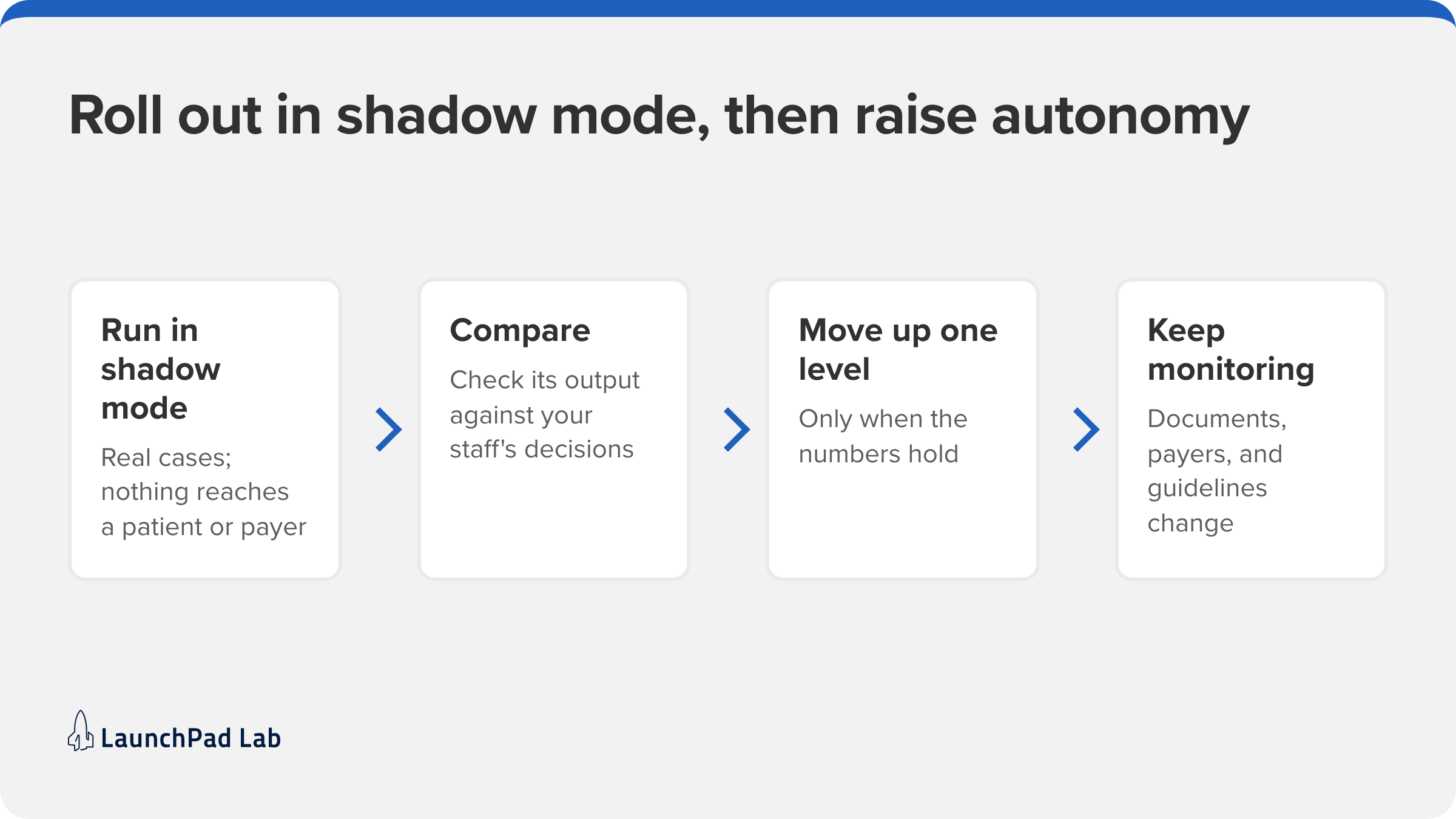
A review of 81 studies in npj Artificial Intelligence found that “no mature and widely adopted framework currently exists” for evaluating healthcare agents. Here’s a simple one:
- Run in shadow mode. The agent works on real cases while your staff keeps doing the work, and nothing it produces reaches a patient or a payer.
- Compare. Check its output against what your people decided on the same cases.
- Move up one level at a time. Raise autonomy only when the numbers hold.
- Keep monitoring after launch. Documents, payers, and guidelines change, and the agent’s performance can change with them.
Measure five things:
- How often reviewers override the agent
- How often it escalates to a person
- Near-misses
- Time saved per case
- Cost per task
When we build agents for healthcare teams, we keep human checkpoints in production where decisions need oversight, and these five measures show whether those checkpoints are working.
Where to start
Pick one workflow with a document backlog, set its autonomy level, and run it in shadow mode. That’s the smallest step that shows whether AI agents in healthcare can take real work off your team without adding risk.
Write down what a wrong answer costs, who reviews the output, and which fields the agent can read. Those three decisions shape everything after, and they’re easier to make with someone who has done it before.
Mapping your workflows to the right autonomy level is the first step of our AI consulting work, and a discovery call is a low-commitment way to begin. Bring one workflow, the systems it touches, and the person who owns the backlog. We’ll help you decide what the agent should do on its own and where a human decides. Schedule a call with our team now.
Frequently asked questions
Which AI agent is best for healthcare?
There’s no single best agent, because the right one depends on the workflow. Compare options on how they handle PHI, how they integrate with your EHR, and how reviewers can check their work, not on a feature list. You can read more about how we approach this on our AI agent development page.
Will AI agents in healthcare become fully autonomous?
Not any time soon for clinical decisions. Most healthcare work belongs at autonomy levels 1 and 2 today, where the agent suggests or drafts and a person decides. Research on diagnostic agents is still mostly simulated. Administrative tasks with hard limits may move higher first, to the levels where the agent acts on its own within set limits.
How long does it take to build an AI agent for healthcare?
We usually start with a Blueprint Workshop, which takes two to six weeks, and a proof of concept or production build follows from there. Longer or more complex scopes take more time. If you’d like a timeline based on your own needs, schedule an AI discovery call, and we’ll map it out together.
Is ChatGPT an AI agent?
A standard ChatGPT conversation is a chatbot. It becomes an agent when it’s set up to pursue a goal, call tools, and act across systems. Confirm a BAA covers any model before PHI goes near it.