

Generative AI development services for mid-market teams
Generative AI should take real work off your team's plate, not just demo well. We build production-grade generative AI: LLM applications, RAG systems, copilots, and document automation, wired into your data and the systems you already run. One in-house team takes you from first call to live, and most builds ship in 8 to 16 weeks.

How our generative AI services help deliver business results
Any team can wire up an API and demo something impressive on clean data. Far fewer can get generative AI to hold up in production: connected to your real systems, trusted by your team, and still accurate six months later. That gap is the whole game, and it is where our generative AI development services focus. Because we are product engineers first, every recommendation is judged against what actually ships on your stack, not a whiteboard theory.
When you are choosing a generative AI development company, that is the difference that matters: a partner who builds software your team relies on every day, not a proof of concept that stalls between the demo and production. We have shipped 760+ production applications over 14+ years for teams in finance, healthcare, and legal, and we bring that same engineering discipline to every AI build.
What we build with generative AI
From content generation to intelligent search and automation, we build AI solutions that reduce manual work, improve accuracy, and fit how your team actually operates.
Custom LLM Application Development
We build custom LLM applications designed around your data and workflows, so the software fits your business instead of forcing your team to fit a template. This is where custom generative AI development services start for most teams: a process that eats skilled hours, and off-the-shelf tools that never quite fit. We build AI assistants, content generation tools, and intelligent search on GPT, Claude, Gemini, and Llama, in Python and TypeScript, wired into your existing stack. It is a form of generative AI software development tuned to your systems, and it draws on the same team as our broader AI software development work.
RAG System Development
We build RAG systems that ground the model in your documents and knowledge base, so answers come from your real information instead of a confident guess. Retrieval-augmented generation (RAG) is the single biggest lever on accuracy, and it cuts hallucinations sharply. When your team keeps re-asking questions whose answers are buried across wikis, PDFs, and tickets, a grounded system hands them answers they can act on. We choose the right vector database, structure your content so the model can find what it needs, and measure retrieval quality over time with LangChain and LlamaIndex. We built Prosci an AI knowledge assistant on OpenAI this way, and it now serves over 10,000 users across 50+ countries.
AI-Powered Content and Document Processing
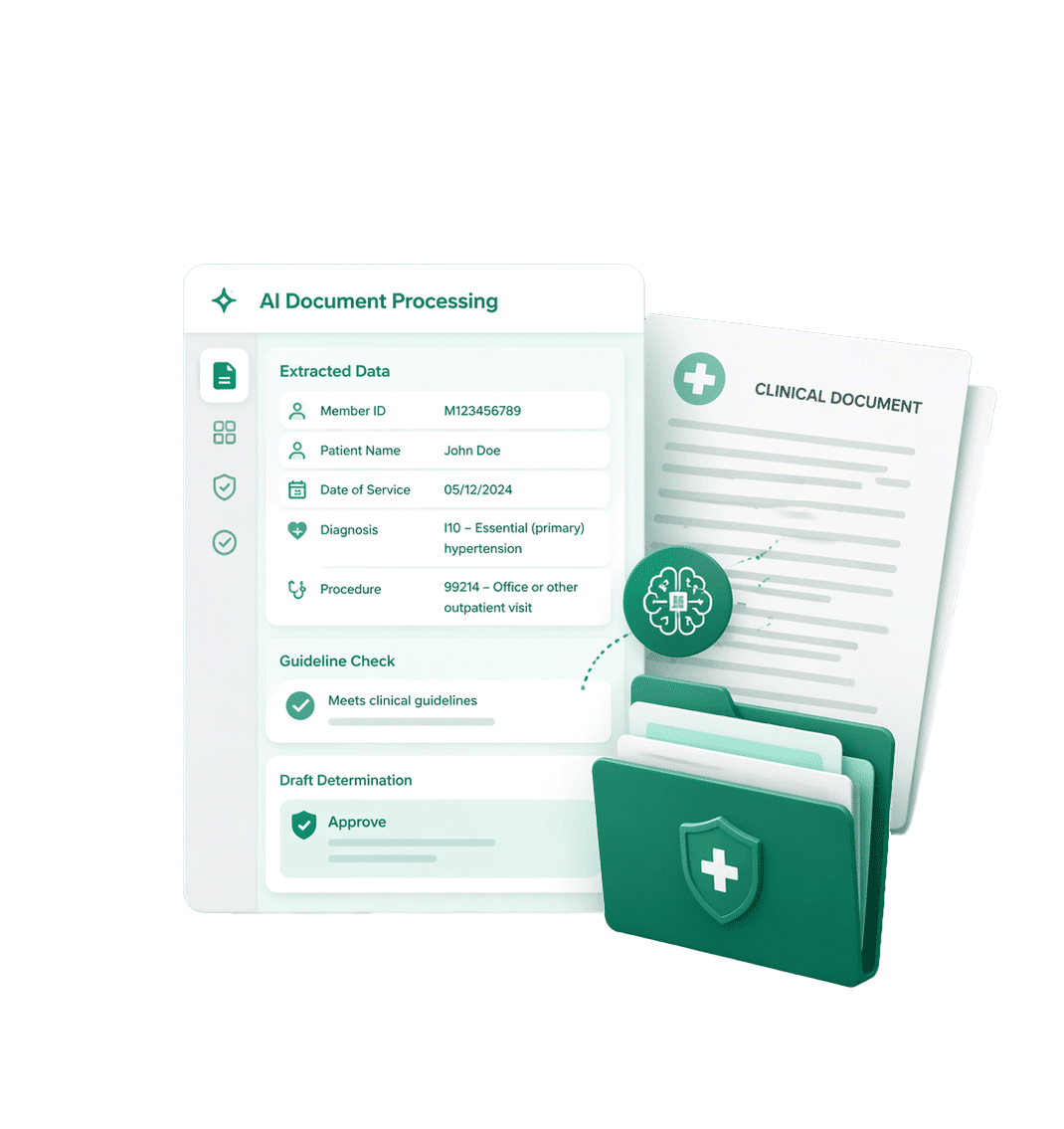
We turn piles of unstructured documents into structured, usable output: extraction, summarization, and review-ready drafts from reports, contracts, forms, and claims. Work that took your team hours of manual review runs in minutes, with a person checking the result instead of producing it. When the backlog only grows, and manual review is slow and inconsistent, this is where generative AI pays back fastest. We build pipelines that apply your business rules and produce drafts your team can trust. For a healthcare insurance platform, our system cut claim-review turnaround from 3 to 4 days to under 24 hours at 85 to 90 percent accuracy.

Conversational AI and Chatbot Development
We build conversational AI that does more than answer: it understands context, reaches into your systems, and takes action. Ask it, and it can update a record, pull live data, or trigger a workflow, not just return a canned reply. When your support queue is full of questions your documentation already answers, an assistant that acts frees your team for the cases that actually need a person. We wire these assistants into your internal systems with the guardrails to run in production.

AI Copilots and Productivity Tools
We build copilots that work alongside your team inside the tools they already use, speeding up a specific job instead of replacing it: drafting, research, coding support, or a decision aid. When your best people lose a third of their week to necessary but repetitive work, a copilot hands that time back for the judgment calls only they can make. We build each one to fit your existing workflow and connect to your data, closely related to our AI agent development work, when the tool needs to act on its own.

AI Automation and Platform Integration
We embed generative AI into the platforms you already run, using APIs to move work between tools without the copy-paste and app-switching that slow your team down. When work stalls in the handoffs, with data re-entered between your CRM and internal apps and tasks waiting on someone to move them, the AI becomes part of the system instead of another tab. We connect LLMs to your workflows through Salesforce, HubSpot, and internal APIs, part of our broader AI automation services.

Generative AI Strategy and Proof of Concept
We help you find where generative AI actually pays off before you commit a budget to a build. A proof of concept is a small working version, built on your real data, that proves the approach in weeks instead of arguing it in slides. When you are under pressure to do something with AI but unsure which idea is worth building, this is the fastest way to a clear answer. We review your workflows, pick the highest-impact use case, and build a focused proof of concept in two to four weeks, the same front door as our AI consulting services. You see real output and validate value before funding a full build.
AI Evaluation, Monitoring, and Optimization
We keep generative AI reliable after launch, the part most teams underestimate: evaluation harnesses, output monitoring, prompt versioning, cost controls, and the guardrails that catch quality drift before your users do. Your AI works on launch day, then a model updates, a prompt changes, your data grows, and accuracy slips before anyone notices. We build evaluation pipelines during the proof-of-concept phase with tools like Braintrust and Langfuse, then rerun them every time a prompt, model, or use case changes, combining automated checks, LLM-based scoring, and human review where the stakes are high.
Technology and models we build on our generative AI development services
We are not loyal to any one provider. We pick the model and the tooling that fit the job, then prove the choice on your data before committing. Where we have deep, repeatable experience, we have documented it on our technology pages. Here is the stack behind our generative AI builds.
- Foundation models: OpenAI GPT, Claude, Gemini, and open-source models like Llama and Mistral. We test a couple before committing rather than defaulting to one.
- Languages and runtime: Python and Node.js, the stack behind most of our AI builds.
- Orchestration and retrieval: LangChain and LlamaIndex for tool use and multi-step workflows, with a vector database sized to your data and retrieval quality measured over time.
- Platform integration: Salesforce, Agentforce, and Salesforce Experience Cloud, where much of our applied AI work ships.
- Cloud and deployment: OpenAI and Anthropic APIs, plus AWS Bedrock and Google Vertex AI when data residency or model ownership matters.
- Evaluation and observability: Braintrust and Langfuse for evaluation harnesses, cost tracking, and drift detection.
Generative AI development services with security and compliance built in
For regulated work, governance is part of the architecture from the first sprint, not a review bolted on before launch. We build generative AI for financial services, healthcare, insurance, and legal teams. In that work, audit logging, access controls, and data handling are not optional.
| Area | → | How we handle it |
| Data handling and retention | → | We define what the model can see, how long anything is retained, and where it runs, including private cloud or on-premises when data residency requires it. |
| Model and vendor selection under constraint | → | When compliance rules out an option, model choice reflects it. We select for what you are allowed to run, not only for raw capability. |
| Human-in-the-loop review | → | Wherever a person should make the final call, the workflow keeps them there, with the AI drafting and a human deciding. |
| PII and PHI | → | Sensitive data is identified, minimized, and protected in the pipeline, so personal and health information is handled to the standard the work demands. |
| Audit logging | → | Inputs, outputs, and decisions are logged so you can show how a result was reached. |
How we build generative AI solutions
Three phases, working software at every checkpoint, and the same in-house team from the first call through launch and beyond.

Discovery and AI readiness (weeks 1 to 2)
Two weeks to find out whether the build is worth making before you spend real budget. We map how work moves through your team, audit the data and systems it would touch, and scope a proof of concept on your real data with success metrics and guardrails agreed up front. You leave with a clear use case and a technical roadmap, not a slide deck that guesses at one.

Agile build and integration (8 to 16 weeks)
Two-week sprints with working software at every checkpoint. The AI plugs straight into the systems that matter, your CRM, databases, and internal APIs, so it reaches your data and moves work forward. If accuracy needs it, we add RAG. Everything runs against real workflows as it is built, so problems surface while there is still time to fix them.

Production launch and continuous optimization
Launch comes with monitoring, cost controls on model usage, and human-in-the-loop checkpoints wherever a person should still decide. Then we stay involved. Prompts get tuned against real usage, models sharpen as you feed them more data, and drift gets caught before your users notice. For teams that want it, this becomes an ongoing relationship as new use cases come up.
Generative AI development or integration: which do you need?
Both come from the same engineering practice; the scope is what changes. Development builds a new AI-first product from the ground up. Integration adds AI features to the software you already run. Most teams we talk to need integration, and our generative AI integration services now live here, too. Here is how to tell them apart.
| Generative AI development | Generative AI integration | |
| What it is | A new AI-first product, built from the ground up | AI features added to the systems you already run |
| Best when | The AI is the core of what you are shipping | The systems work, and you want them smarter |
| What we deliver | A custom application: model, data pipeline, and interface | LLM features wired into your CRM, apps, and workflows |
| Typical buyer | Teams launching something new | Teams improving what they already operate |
Industries we serve with generative AI
Financial Services
We build AI into reporting, research, and back-office workflows, wired to your core systems and traceable where accuracy and audits matter. For one actuarial firm, an AI-enhanced workflow delivered 10x faster reporting cycles.

Healthcare
We build document and claims processing that speeds decisions without loosening the accuracy standard, with human review kept where it belongs. On a healthcare insurance platform, our system cut claim-review turnaround from 3 to 4 days to under 24 hours at 85 to 90 percent accuracy.

Legal
We build tools that summarize, extract, and search across large volumes of legal documents, grounded in your material, so citations trace back to a real source.

Featured Generative AI Projects

AI-Powered Knowledge Assistant for Prosci
Prosci needed a better way for users to access and use its large library of research, training content, and tools. Information was spread across systems and was difficult to search. We built an AI-powered assistant using OpenAI that pulls from Prosci’s content and delivers clear, relevant answers. This improved how users find information and learn from it. The platform now supports over 10,000 users across 50+ countries, with faster access to the content they need.

AI Document Processing for a Healthcare Insurance Platform
A healthcare insurance platform needed to speed up claim reviews without losing accuracy. Nurses were reviewing unstructured clinical documents manually, which slowed decisions and created inconsistencies. We built an AI document processing system that extracts key data, applies clinical guidelines, and generates draft determinations for review. The result was a faster and more consistent workflow, with turnaround times reduced from 3 to 4 days to under 24 hours and accuracy reaching 85 to 90 percent.

AI-Enhanced Self-Service Hub for Bullhorn
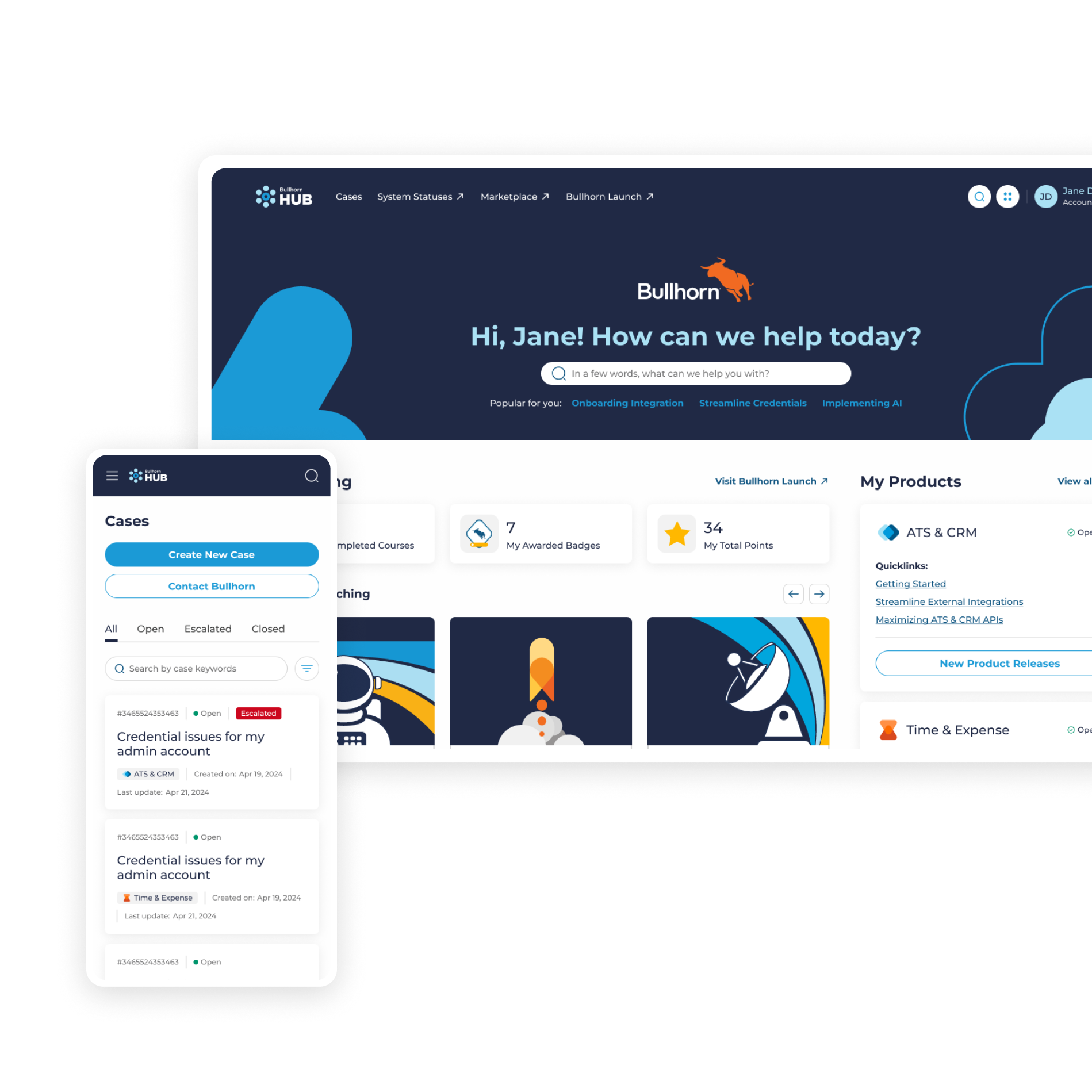
Bullhorn needed to improve efficiency and reduce support overhead across its platform. LaunchPad Lab built an AI-enhanced self-service hub that helps users find answers, navigate workflows, and complete tasks faster without relying on support teams. The result was improved efficiency and a better user experience across the platform.
Frequently Asked Questions
What are generative AI development services?
It is a service that focuses on building AI that can do real work for your team. That might be generating content, answering questions, or handling documents. The important part is making sure it works with your data and fits into how your business already runs.
How do you prevent AI hallucinations in generative AI applications?
You reduce hallucinations by grounding the AI in real data and testing it in real scenarios. We also add checks and, when needed, keep a human involved so the output stays reliable.
Can generative AI be integrated into our existing software?
Yes. In most cases, that’s the goal. We build generative AI to connect to your current systems so it can work within your existing workflows, instead of replacing them.
How long does a generative AI project take?
It follows a pattern. The architecture phase is usually two weeks. A proof of concept takes two to four weeks. A production-ready build most often takes eight to sixteen weeks, depending on how much it touches and how clean your data is. Larger platform builds run six months or longer. We give you a clearer estimate after the architecture phase, once we know what we are working with.
Do you handle SOC 2, HIPAA and other regulated requirements?
Yes. We have shipped AI features in financial services, healthcare, and insurance, where audit logging, access controls, PHI handling, and data residency are not optional. Our work on a healthcare insurance platform’s AI claim review was built inside a HIPAA-compliant framework with audit-ready outputs and security protocols at every step. Compliance is part of the architecture from the start, not something we retrofit before launch.
What is RAG (retrieval-augmented generation)?
RAG is a way to connect AI to your data. Instead of guessing, the model pulls in real information from your documents and systems. This helps it give more accurate, relevant, and useful answers.
How much does it cost to build a generative AI application?
Cost tracks with scope. A focused proof of concept that proves one use case on your real data runs for two to four weeks. A production build with proper architecture, integrations, and monitoring typically runs eight to sixteen weeks. The variables that move the number most are how many systems the AI has to talk to, how clean your data is, and whether the output needs human review before it reaches a customer. We start most engagements with a fixed-scope discovery, so you know the investment before committing to a build.
What LLM and AI models does LaunchPad Lab work with?
We work with models like GPT-5, Claude, Gemini, and Llama, plus open-source options like Mistral when data ownership matters. The right choice depends on your use case and the output you need, and we usually test a couple before committing. Our technology section above lists the full stack.
How do you choose a generative AI development company?
Look for shipped production AI, not demos. Ask for named clients with real numbers, ask how they ground the model in your data, and ask what happens after launch, because most projects stall in the gap between pilot and production. A good partner scopes a small proof of concept on your real data before asking you to commit to a full build. That is how you find out whether the work holds up before the budget is spent.

Let’s Explore What Generative AI Can Do for Your Business
Tell us about the workflow you want to improve. We will help you understand where generative AI can add real value and where a simpler solution might make more sense.
You don’t need a full plan to get started. We can talk through your current process, what is slowing your team down, and what you have already tried.