
You have a business system to scope. It might be a client portal, an internal workflow tool, or the platform that finally retires the spreadsheets your operations team runs on. Before anyone talks to vendors, your CFO or board wants to know the custom software development cost, and they want one number. A range that stretches from a small internal tool to a large enterprise platform is too wide to put in a budget.
The range gets narrower once you know what’s driving it. On the builds we’ve priced at LaunchPad Lab, the cost of a project comes down to how many systems it connects to, how clean the data is, and how much of the workflow is genuinely new.
By the end, you’ll know which band your project sits in, why, and what to ask a vendor before you accept their number.
TL;DR
- Custom software development cost for a business system usually runs from $50,000 to $200,000 or more, depending on scope.
- Integrations, data cleanup, and genuinely new workflow move the number more than features do.
- Choose the pricing model by how settled your scope is. A fixed price fits a written, stable scope, time and materials fits one that will change, and outcome-based pricing pays only for accepted results.
- Budget hosting, licenses, monitoring, and support as their own yearly line, sized from what the system touches.
- Before you commit to the full build, pay for a short discovery phase that ends with a number for your own scope.
How much does custom software development cost by project type?
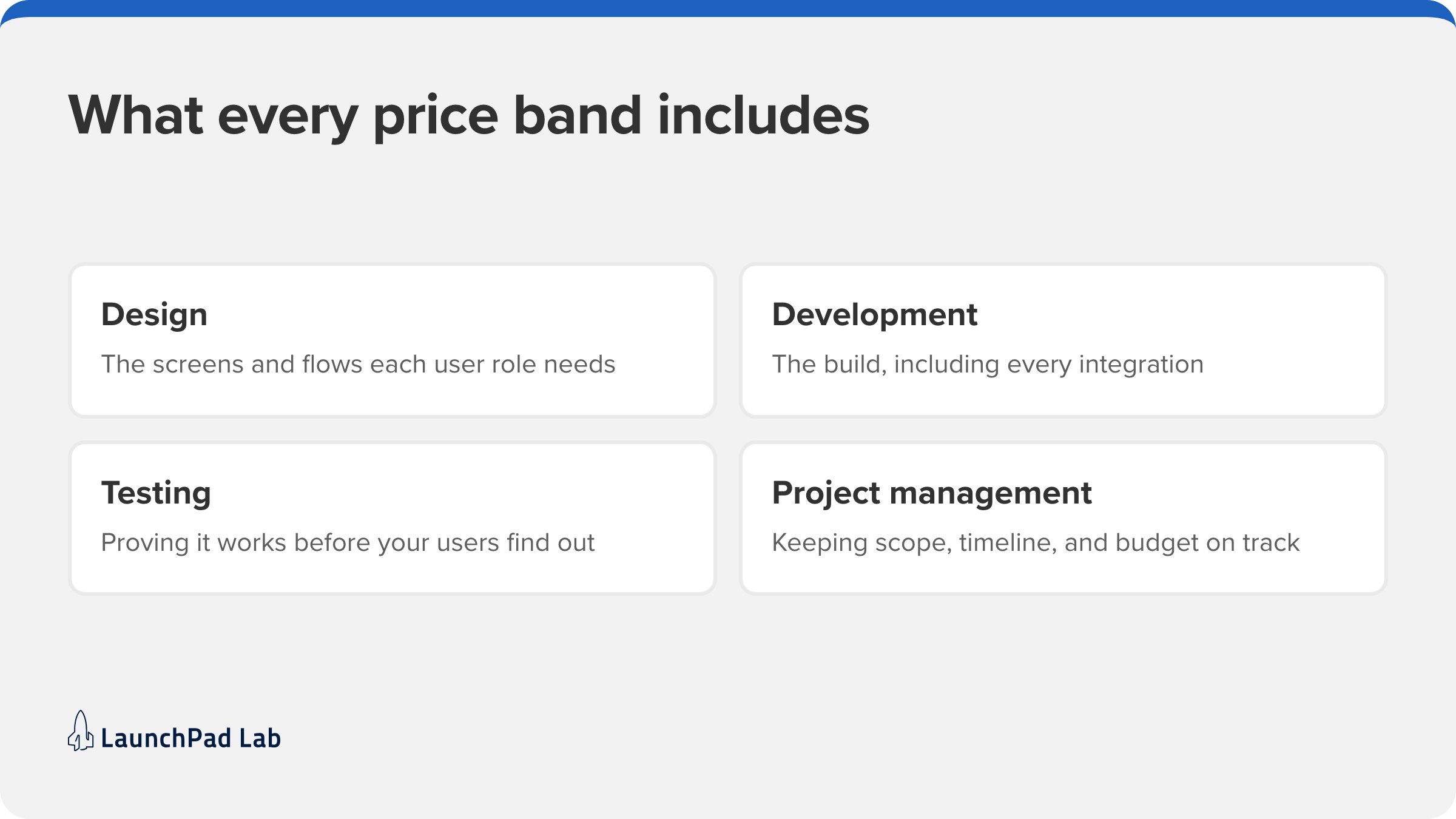
Custom software development cost for a business system runs from about $50,000 for a focused first version to $200,000 or more for an enterprise platform. Scope decides where yours falls, and on business software, scope mostly means the systems it has to work with and the people who will use it. Every band below includes design, development, testing, and project management, so each one is the full price of a launch-ready system.
| Band | What’s usually in scope | Example |
| Focused first version: $50,000 to $100,000 | One core workflow, one or two user roles, a simple admin panel, and few or no integrations | An approval or scheduling tool for one team |
| Business system with integrations: $100,000 to $200,000 | Several user roles, connections to your sales, finance, or billing systems, reporting, and a data migration | A client portal that pulls from your CRM and billing system |
| Enterprise platform: $200,000+ | Single sign-on, several integrations, role-based permissions, audit trails, and a compliance review | A regulated platform used by thousands of people across many organizations |
They’re the same bands we use in our guide to what it costs to develop an app. A business app and a business system are priced the same way, by the work involved. For an outside check, Clutch’s 2026 pricing guide puts the average software development project across its verified reviews at $132,480, which lands in our middle band.
If you’re weighing a build against hiring, the Bureau of Labor Statistics puts the median US software developer salary at $135,980 a year as of May 2025. That’s one person, before benefits, management, design, and testing, which is why a team quote and a salary are hard to compare directly.
Find the three inputs that move a custom software budget
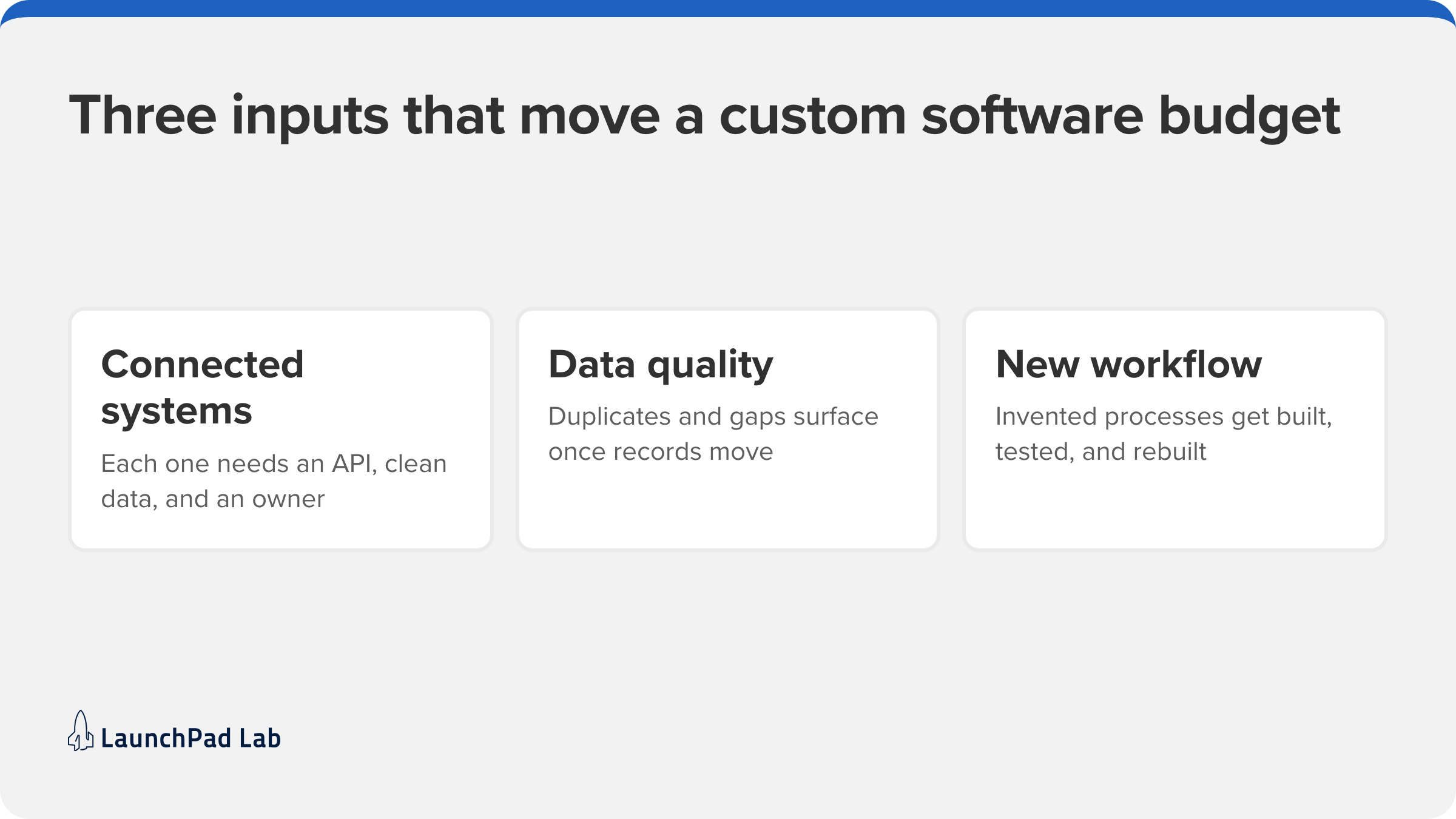
When we scope a custom build, three things decide which band it lands in, and we look at all three before we put a number on anything. You can do the same on your own project before you call a vendor.
1. Count the systems the software has to connect to
Connecting to your ERP (enterprise resource planning system), your CRM (customer relationship management system), a payment provider, or a legacy database is where business software budgets go. Each integration needs an API, clean data on the other side, and someone who owns that system. Older systems are the hardest, because the documentation is often missing. In our estimates, integrations move the number more often than any feature does.
We saw how much one integration can carry when we worked with Lamacchia Realty, a real estate brokerage. Its leads came in through Salesforce, went out to AWS for the assignment logic, and came back through API calls. As the database and the agent roster grew, that round trip led to slow processing, timeouts, and data errors. The project was a rebuild of that sync and the assignment logic behind it.
The business systems we build are usually web platforms that sit on top of systems like these. That’s the work our custom web application development team takes on. Before you ask anyone for a quote, list every system the software reads from or writes to, and note which ones have a documented API.
2. Check how clean your data is before you scope
Data migration and cleanup are the line items we see buyers underestimate again and again. Records that look fine inside the old system turn up with duplicates, missing fields, and inconsistent formats once someone tries to move them. As we put it in our custom software vs. off-the-shelf guide, “Moving ten years of inconsistent records often outweighs building the software that will hold them.”
Flexco, an automotive remarketing company, is a good example from our own work. Before we built its new client portal and revamped its bidding app, our team had to map hard-to-reach vehicle data to a new data model. Then we wrote custom scripts to migrate over a million records. The migration had to come first, before design and development of either app started.
Ask for a real export, a few thousand rows from each source, and look at it before anyone scopes the build. The duplicates and gaps you find now cost far less than the ones a team finds halfway through.
3. Decide how much of the workflow is genuinely new
A workflow that follows a familiar pattern, such as approvals, a client portal, or reporting, costs less than one your team is inventing as it goes. When the process is new, the team builds a version, users try it and find the gaps, and the team builds again. Each round adds time and cost.
That loop is also where scope creep starts with slow growth of requirements during a build. If nobody has written down how the new process should work, every review adds something, and each addition sounds reasonable on its own. We ask clients to mark which steps copy something their team already does and which ones don’t exist yet.
Once you’ve looked at all three, give each one a low or high score:
- Systems: low if the software stands alone or connects to one modern system with a documented API. High if it touches several systems or an older database.
- Data: low if the data already lives in one place and is mostly clean. High if it’s spread across systems and spreadsheets, or built up over years of inconsistent entry.
- Workflow: low if the software digitizes a process your team already runs. High if the process is being designed alongside the software.
Three lows usually put a project in the first band. A high on systems or data is what typically moves a project into the second, and the reason should show up in any estimate you’re given.
Which custom software development pricing model fits your scope?
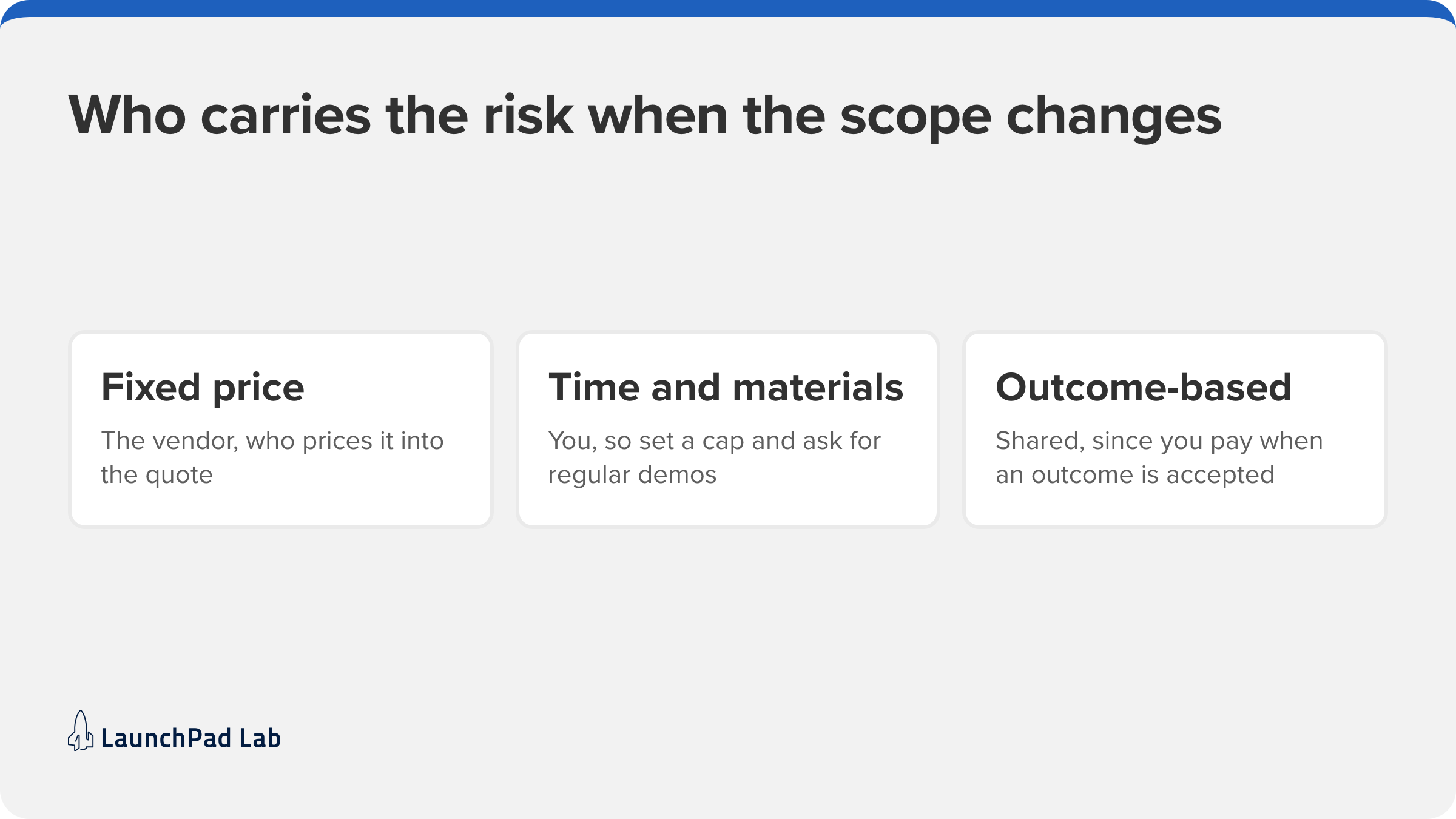
The model we recommend depends on how settled the scope is, because custom software development pricing decides who pays when the scope changes. With a fixed price, the vendor carries that risk and charges for it up front. With time and materials, you carry it and pay for the work as it happens. Outcome-based pricing ties each payment to a result you accept.
| Model | Best when | Who pays when the scope changes |
| Fixed price | The scope is written down, small, and unlikely to change | The vendor, who prices it into the quote |
| Time and materials | The scope will move as users see working software | You, so you need a cap and regular demos |
| Outcome-based | You can define what “done” means for each piece of work | Shared, since you pay when an outcome is accepted |
Is fixed price cheaper than time and materials?
Only when the scope is stable. Vendors price the risk of change into a fixed number, and anything outside the original spec comes back as a change request. On a well-defined build, that’s a fair trade. On a business system whose workflow is still being worked out, you often end up paying for both the buffer and the change requests.
Time and materials costs what the work costs, which suits a scope you expect to move. Two controls keep it predictable. Set a budget cap with a check-in before you reach it, and ask for a demo of working software every week or two.
When does outcome-based pricing make sense?
Outcome-based pricing pays for delivered results instead of hours worked. It fits when the work can be split into pieces you can check, such as a feature that passes acceptance testing or a workflow that runs end to end. It’s also how we work. Under our Nova delivery model, clients pay for shipped software rather than time spent, and credits are spent only when outcomes are accepted.
What changes for you is how you compare quotes. Instead of setting one hourly rate against another, you compare what each vendor commits to deliver and what you pay once it’s accepted.
Compare custom software development rates by team location
Custom software development rates vary a lot by country, and the hourly rate is usually the first number buyers compare. Here’s how the averages in that same Clutch guide compare across five countries buyers often consider:
| Country | Average hourly rate on Clutch |
| United States | $50 to $99 |
| Canada | $100 to $149 |
| Poland | $50 to $99 |
| Mexico | $25 to $49 |
| India | $25 to $49 |
Much of the market sits toward the lower end. In Techreviewer’s 2026 survey of 127 software development providers, the $30 to $49 per hour range was the largest tier, at 37.8% of respondents.
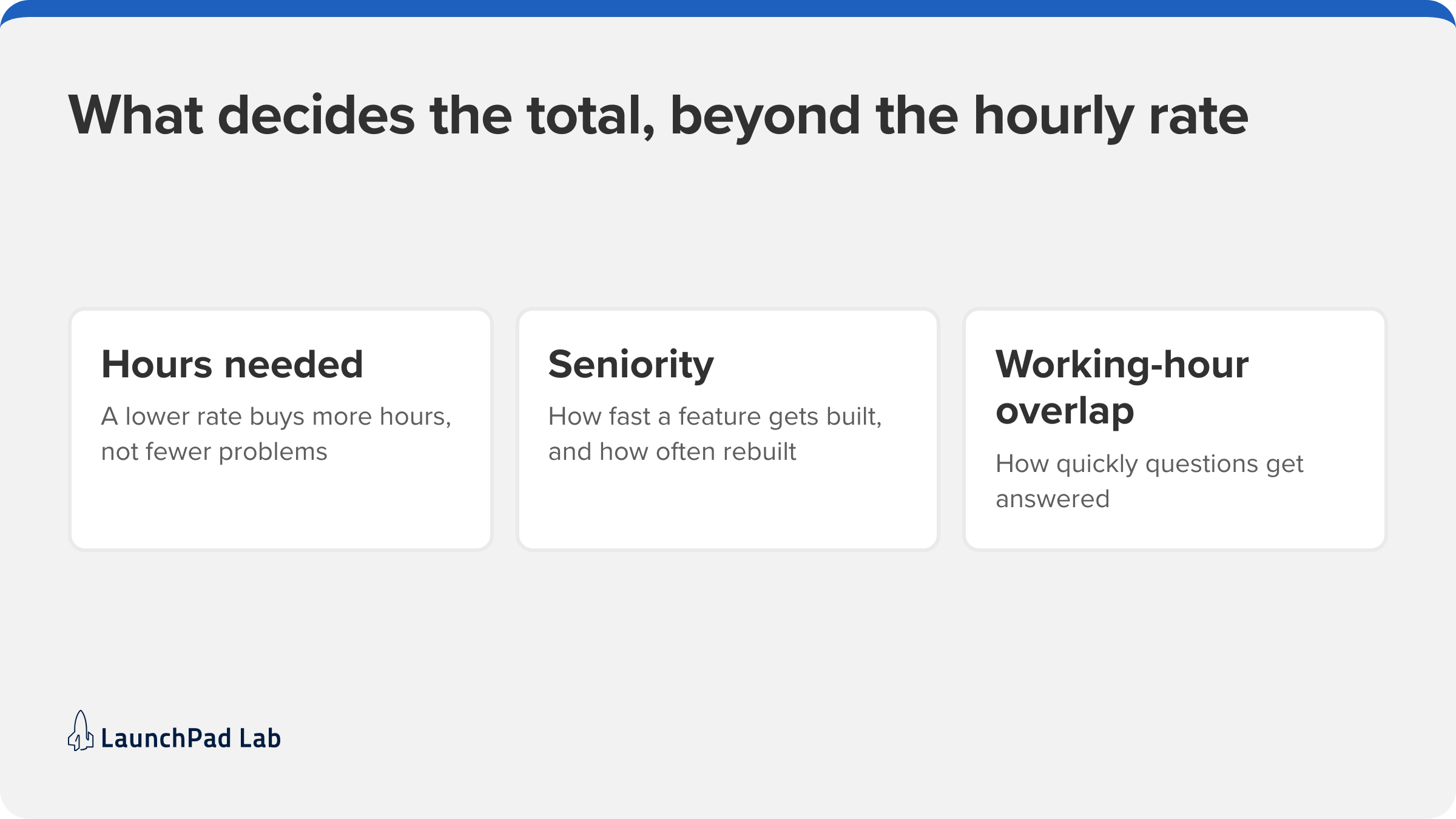
A lower rate doesn’t guarantee a lower total, though. In the quotes we review with clients, the gap between two totals comes far more from how many hours each team needs than from the rate itself. Seniority decides how fast a feature gets built and how much of it gets rebuilt later, and overlap in working hours decides how quickly questions get answered. So we’d compare quotes on what they include first and on rate second.
How much should you budget for maintenance after launch?
We budget maintenance as its own yearly line, built from what the system touches, rather than as a flat percentage of the build. You’ll see a percentage rule of thumb in a lot of guides, and it’s a fair sanity check. Fullstack’s 2026 price guide notes it can’t trace the often-repeated 15 to 25% figure to a primary source, though, so it shouldn’t be the number you defend.
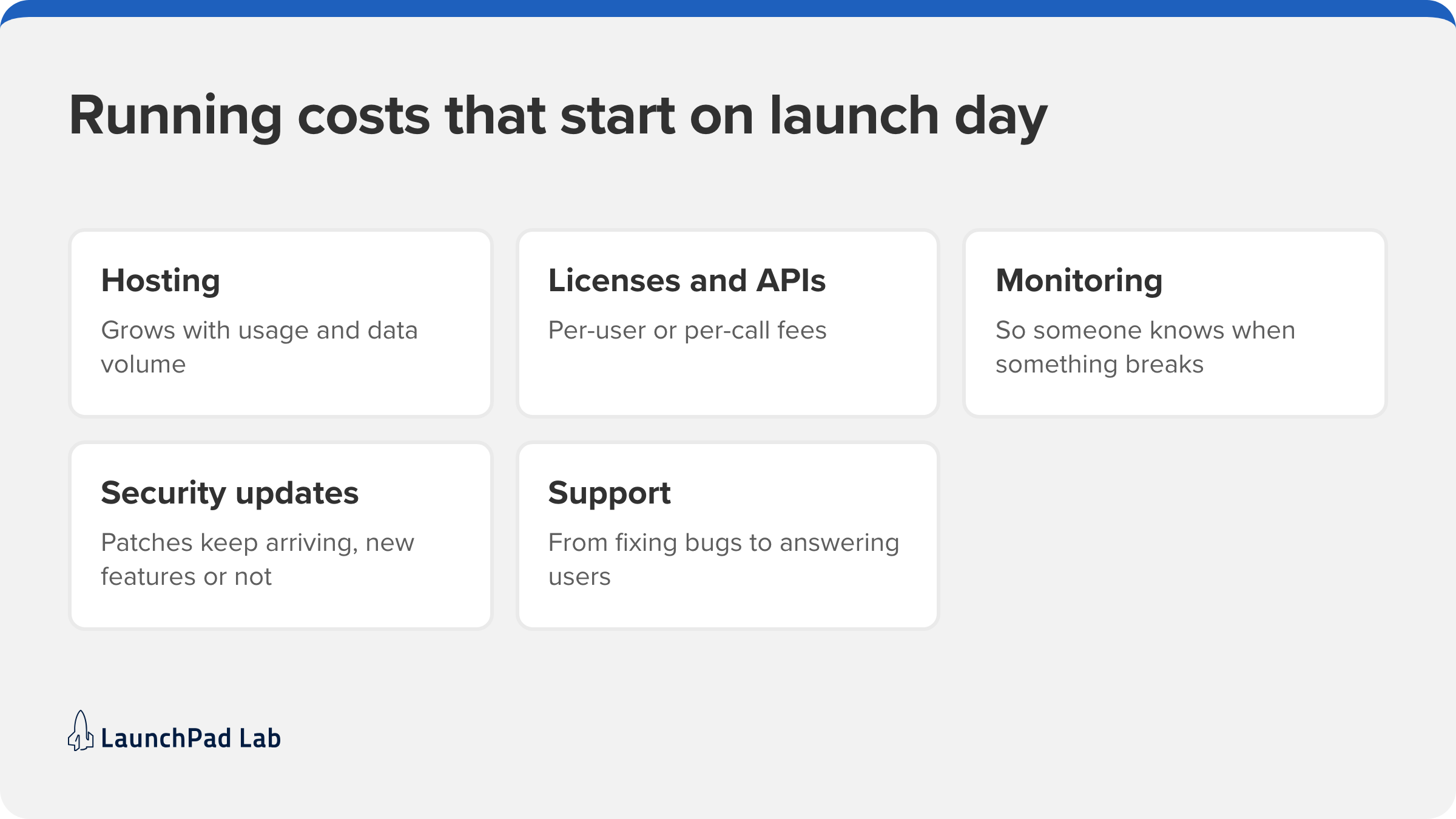
List the running costs that start on launch day
These costs begin the day the system goes live, whatever the build cost:
- Hosting and infrastructure, which grow with usage and data volume.
- Third-party licenses and APIs, including any per-user or per-call fees.
- Monitoring and alerting, so someone knows when something breaks.
- Security patches and dependency updates, which keep arriving whether or not you add features.
- Support, from fixing bugs to answering users’ questions.
Add those up over three years, and you have the running half of the total cost of ownership, the full cost of building the system and keeping it running. Set that figure against an off-the-shelf subscription, and our three-year cost comparison works through the math.
Plan a yearly maintenance line before you sign
To size the line, put a yearly figure on each running cost above, using vendor quotes where you have them. Then, before the contract is signed, agree with the vendor on who fixes what, how fast they respond, and what counts as a new feature rather than maintenance. Without that last one, every small request turns into a debate about who pays.
If you’d rather not staff that work in-house, our managed support and enhancement team takes it on after launch, so your own team stays on the roadmap.
Get a software development cost estimate you can defend
Before a client asks any vendor for a number, we tell them that an estimate is only as good as the scope behind it. A number you can defend comes from the systems listed, the data sampled, and the workflow mapped, and that work happens before the build is priced.
Pay for a scoped discovery phase before the build
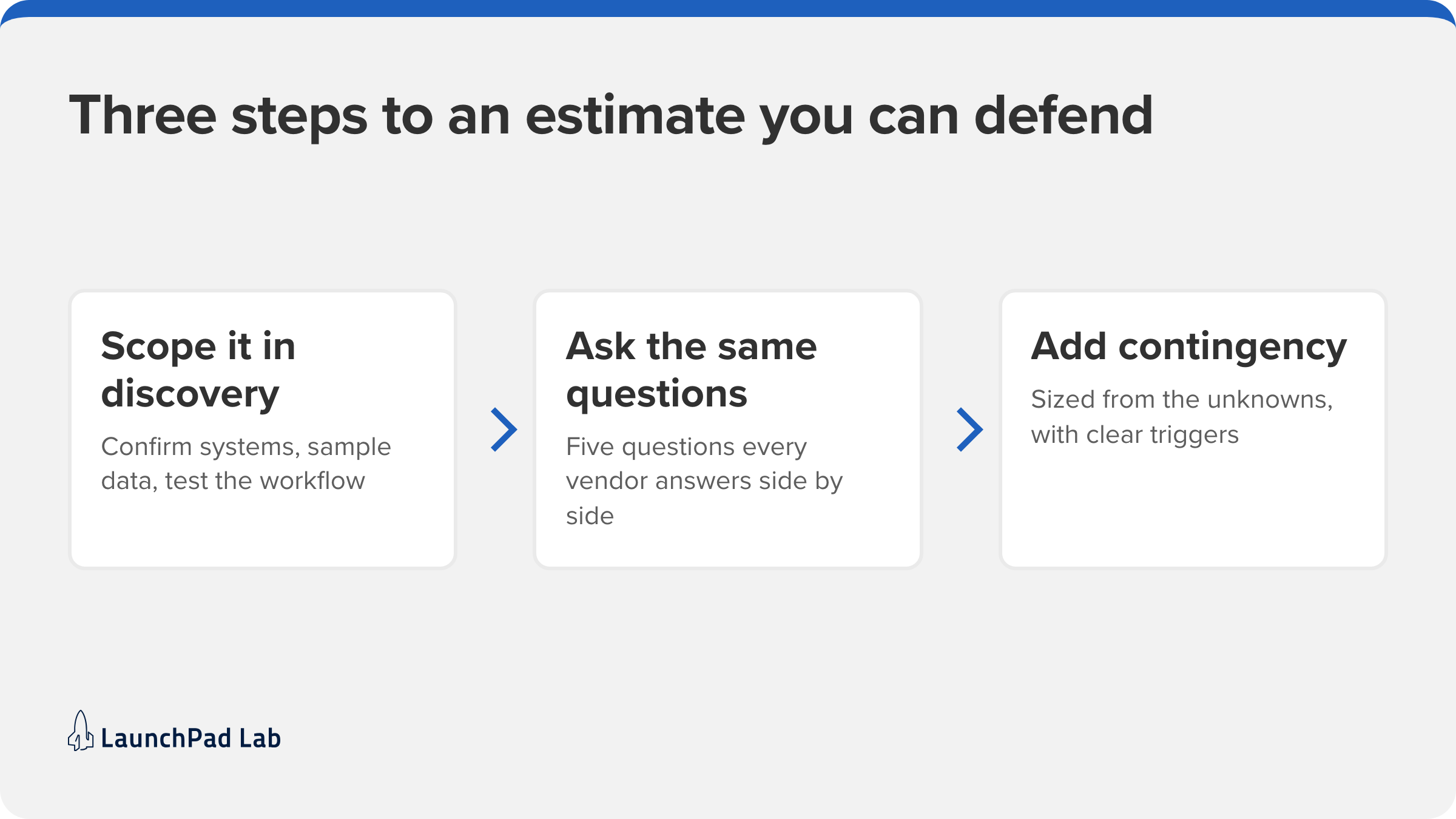
A discovery phase confirms the systems, samples the data, and designs and tests the new parts of the workflow with users. Ours is the Blueprint Workshop, a collaborative engagement that usually runs 2 to 6 weeks and ends with a firm estimate for your specific build.
We start there because discovery and prototyping are where scope gets pinned down, and they’re part of our product strategy and design work. Whoever you hire, pay for this step on its own. That way the estimate at the end is built on your scope.
Ask every vendor the same five questions
Quotes only compare when they answer the same questions. These are the five we’d ask, and we’d keep the answers side by side:
- Which systems does this estimate assume we connect to, and how?
- What data cleanup and migration does it include?
- Which pricing model is it based on, and what happens when the scope changes?
- What’s excluded, such as hosting, licenses, and support after launch?
- What does the first release include, and what’s left for later?
When two quotes differ widely, the answers usually show why. One vendor has assumed clean data, left out hosting, or priced a bigger first release.
Add a contingency line you can explain
Size contingency from the unknowns the three inputs reveal, instead of picking a percentage. A project that scored low on all three needs less. An undocumented legacy system, data nobody has sampled, or a workflow nobody has tested each needs its own share. Write down what would trigger spending it, such as an integration that turns out to need extra middleware. Then finance can see what each part of the line is for.
Where to start: set your custom software budget before vendor calls
A custom software development cost you can defend starts with the right band. From there, the systems the software connects to, the state of your data, and how much of the workflow is new explain where in that band you sit. The pricing model decides who carries the risk when the scope moves. The running costs and contingency complete the picture, so nothing surprises finance in year two.
The step that turns all of this into a real number is a scoped discovery phase. If you’d like a second opinion on an estimate you already have, or a scoped number for your own build, we’re happy to help.
Book a Blueprint Workshop or talk to our team.
Frequently asked questions
Does AI reduce the cost of custom software development?
It lowers the cost of writing code, but not of deciding what to build, cleaning data, or connecting systems. Those three are where much of a business system’s budget goes. Our Nova model is built on AI coding tools, with senior engineers approving every release. As we put it, “AI accelerates execution. Humans remain accountable for decisions and outcomes.”
Why do custom software quotes vary so much?
Vendors assume different scope. One quote includes data migration and three integrations, while another assumes one system and clean data. They also use different pricing models and charge different rates, from about $25 to $149 an hour on Clutch, depending on the country. Ask every vendor the same questions about systems, data, pricing model, exclusions, and the first release, and the gap usually explains itself.
How long does custom software take to build?
At LaunchPad Lab, production web builds typically run 6 to 12 weeks after the Blueprint Workshop, and larger platforms take longer. Clutch’s verified reviews put the typical software development project at about 13 months. The same three inputs that move the cost, the systems, the data, and how new the workflow is, move the timeline too.