
Your company has approved the use of AI. There’s a budget, a few pilots, and probably a slide with a seven-step AI implementation strategy. What’s often missing is a system that runs every day on real data, with someone accountable for it. That gap is where AI projects stall, and it usually has little to do with the model.
Getting from pilot to production comes down to a handful of practical decisions: which workflow to start with, what data it needs, who checks the output, and what happens when the agent gets it wrong. At LaunchPad Lab we build these systems for clients, and those are the decisions we help them get right first.
You’ll get the five-step plan we use, with the agent-specific choices that generic lists leave out.
TL;DR
- An AI implementation strategy succeeds or fails on the workflow, the data, and the review process, far more than on the model.
- Build the roadmap in five steps, and don’t move on until each one passes its exit test.
- Choose a framework, a platform, or a custom build based on who will maintain the agent.
- Before launch, answer yes to six readiness questions, from clean data to a measurable pilot. That’s when you know you’re good to launch.
What is an AI implementation strategy?
An AI implementation strategy is the structured plan for turning approved AI goals into systems that run in production. Your AI strategy says where AI should help the business. The implementation strategy says how:
- which use cases go first
- what data they need
- who owns them
- how you’ll know it worked
If you’re still deciding if AI is worth the effort, that’s the purpose of our AI consulting engagement where we help you decide how to ship and use AI.
Why AI agents change the implementation plan
Earlier AI projects shipped a model that predicted something for a person to act on. An agent acts on its own conclusions: it reads a ticket, calls a tool, updates a record. Once software takes actions, your plan has to cover permissions, escalation, and monitoring as well as accuracy.
The same three things that make AI agents useful each add work to the plan.
- Scale. You can copy an agent across teams in days, so a flaw copies just as fast.
- Autonomy. Agents work without constant prompting, which is why they need written rules about when to stop and ask.
- Adaptability. Agentic AI shifts as its data and prompts change, so it needs drift monitoring.
How do you build an AI implementation roadmap?
Build your AI implementation roadmap in five steps, and give each one an exit test: a condition to meet before the next one starts. Teams tend to skip this step, which is why pilots drift. Here’s a glance at each step, who owns it, and when you’re ready to move on.
| Step | What you decide | Who owns it | Ready to move on when |
| 1. Define value and use cases | The first workflow, and what “better” means | Business sponsor | One use case has a baseline number |
| 2. Design for agentic architecture | What the agent may read, write, and trigger | Engineering lead | Permissions and escalation are written down |
| 3. Integrate data and workflows | Which systems the agent connects to | Data and platform owners | The agent can reach clean, current data |
| 4. Pilot, test and iterate | How the agent is judged | Product owner | Results beat the baseline
|
| 5. Scale with governance | Oversight, audit and risk controls | Risk or compliance lead | Monitoring and review are running |
Step 1. Define value and use cases
Pick a workflow that is frequent, measurable, and painful today, and record how it performs now. That number is the pilot’s baseline.
Step 2. Design for agentic architecture
Map what the agent can see and do before you choose tools. You can use the patterns in our AI agent architecture guide. Decide what it may trigger without asking.
Step 3. Integrate data and workflows
Gartner predicted in 2025 that through 2026, organizations will abandon 60% of AI projects that aren’t supported by AI-ready data. Test the agent’s access against the live systems it will use, not a one-off export.
Step 4. Pilot, test, and iterate
Set up the evaluation before the pilot starts. Keep a human-in-the-loop review on every output during the pilot, so a person catches errors before customers do.
Step 5. Scale with governance
Write your oversight rules down before you scale. The NIST AI Risk Management Framework gives US teams a voluntary structure for managing AI risk. If customers or auditors need proof, ISO/IEC 42001 is the certifiable standard for an AI management system.
AI agent implementation strategy: framework, platform, or custom build?
Once you know what the agent should do, decide how to build it: on an open framework, on a platform you already run, or as a custom build on a large language model. Decide who will maintain the agent after launch, since each route leaves you owning something different.
| Route | Pick it when | What you’ll maintain |
| Open framework | You have engineers and want control over every step | The code, the hosting, and every upgrade |
| Platform in software you already run | The workflow already lives in your CRM or service desk | Configuration, within what the vendor supports |
| Custom build | The workflow is unusual, and no product fits it | Everything, including evaluation and monitoring |
On the framework route, three options come up often:
LangGraph gives you low-level control over long, stateful workflows.
CrewAI groups agents into collaborating crews, which suits work that naturally splits into roles.
The OpenAI Agents SDK keeps to a few building blocks: agents, handoffs between them, and guardrails.
Our AI agent frameworks guide compares more. Whichever route you pick, the Model Context Protocol is an open standard for connecting AI applications to data and tools, so one integration can serve several agents. If you’d rather not own that stack, our AI agent development team can take it on and help you implement it.
What AI implementation looks like in practice
We’ve implemented AI for a lot of clients, and these three projects show how we work. Each one started with data that was scattered, unstructured, or locked in legacy systems.
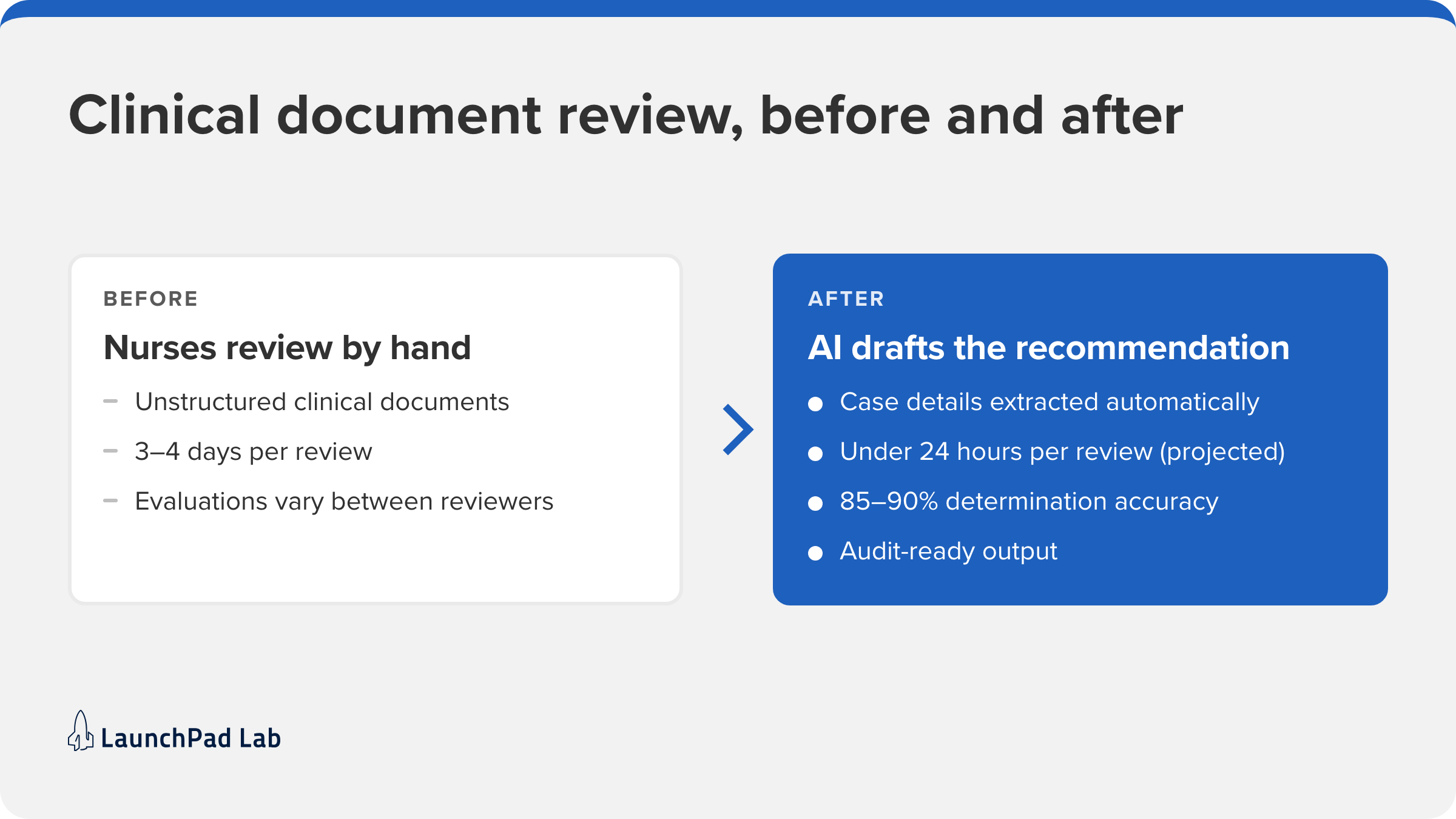
- We worked with a healthcare insurance platform where nurses reviewed clinical documents by hand under HIPAA rules. The system we built extracts the case details, checks them against clinical guidelines, and drafts an audit-ready recommendation. It reaches 85–90% determination accuracy, and review time is projected to drop from 3–4 days to under 24 hours.
- For an actuarial consulting firm, reports were taking up to 60 days. Our AI-driven parsing and automated validation made turnaround 10x faster, with a projected $2M annual profit increase.
- With Bullhorn, we put an AI agent inside their customer self-service hub. It answers from the knowledge base and hands off to live support, and support case volume has gone down since the hub launched.
One thing we see on builds like these: the data work takes longer than the model work. So our AI software development team plans in that order: data and review first, model second.
Why AI implementations stall, and how to avoid it
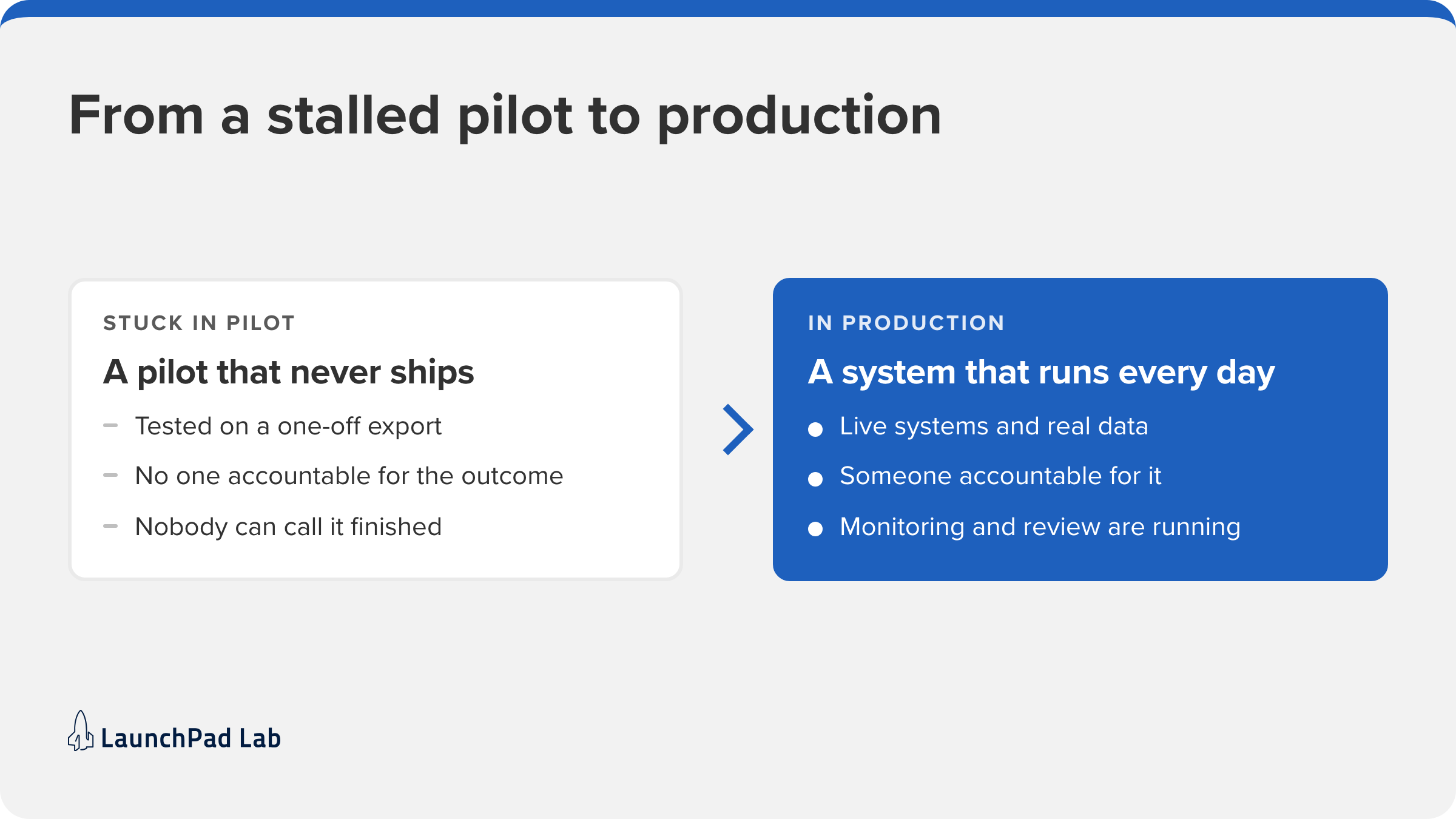
AI projects stall for organizational reasons more often than technical ones. BCG’s 10-20-70 rule (2024) puts the bulk of the effort on people and processes, and in our experience that’s also where the delays start. Four problems keep coming up:
- No measurable objective. Without one, nobody can call a pilot finished.
- Poor data readiness. Disconnected systems cap what any agent can do.
- Change management left for later. People who weren’t consulted will route around the agent. Role-based training, such as our AI agent workshops, gets them hands-on with it before launch.
- Governance planned after launch. Escalation rules and audit trails get written after the first incident.
AI implementation readiness checklist
You’re ready to launch an agent when you can answer yes to all six of these questions.
- Is the first use case tied to a business goal someone owns?
- Is the data it needs clean, connected, and accessible?
- Do your systems expose secure APIs the agent can use?
- Do IT, product, and the business team share ownership?
- Are oversight, compliance, and human-in-the-loop review defined?
- Can you measure the pilot against a baseline?
What to do next
A good AI implementation strategy reads like a work plan: one use case, a baseline, an owner for every step, and review rules written before launch. If you can answer yes to every question on the checklist, pick your first workflow and set its baseline this month.
We build these systems with our Nova delivery model, where AI writes production code,senior engineers shape and review it, and you pay for outcomes rather than hours.. If you’d like a second opinion on your plan or your first use case, book an AI Quick Start conversation.
Frequently asked questions
How long does AI implementation take?
It depends on your data more than the model, and it runs in three phases: discovery, pilot, and scale. A pilot on one well-scoped workflow can run in weeks when the data is ready. Production, with integrations, monitoring, and review, usually takes a few months.
What is the 10/20/70 rule for AI?
BCG’s 10/20/70 rule (2024) says successful AI programs put 10% of their effort into algorithms, 20% into technology and data, and 70% into people and processes. In practice, plan training and process change before you pick a model.
How do you get stakeholder buy-in for an AI agent rollout?
Give developers and business stakeholders one shared number from the workflow you’re automating. Let the people who do that work today design the review step. Name one owner, and show pilot results before asking for a wider launch.
When should an agentic workflow keep a human in the loop?
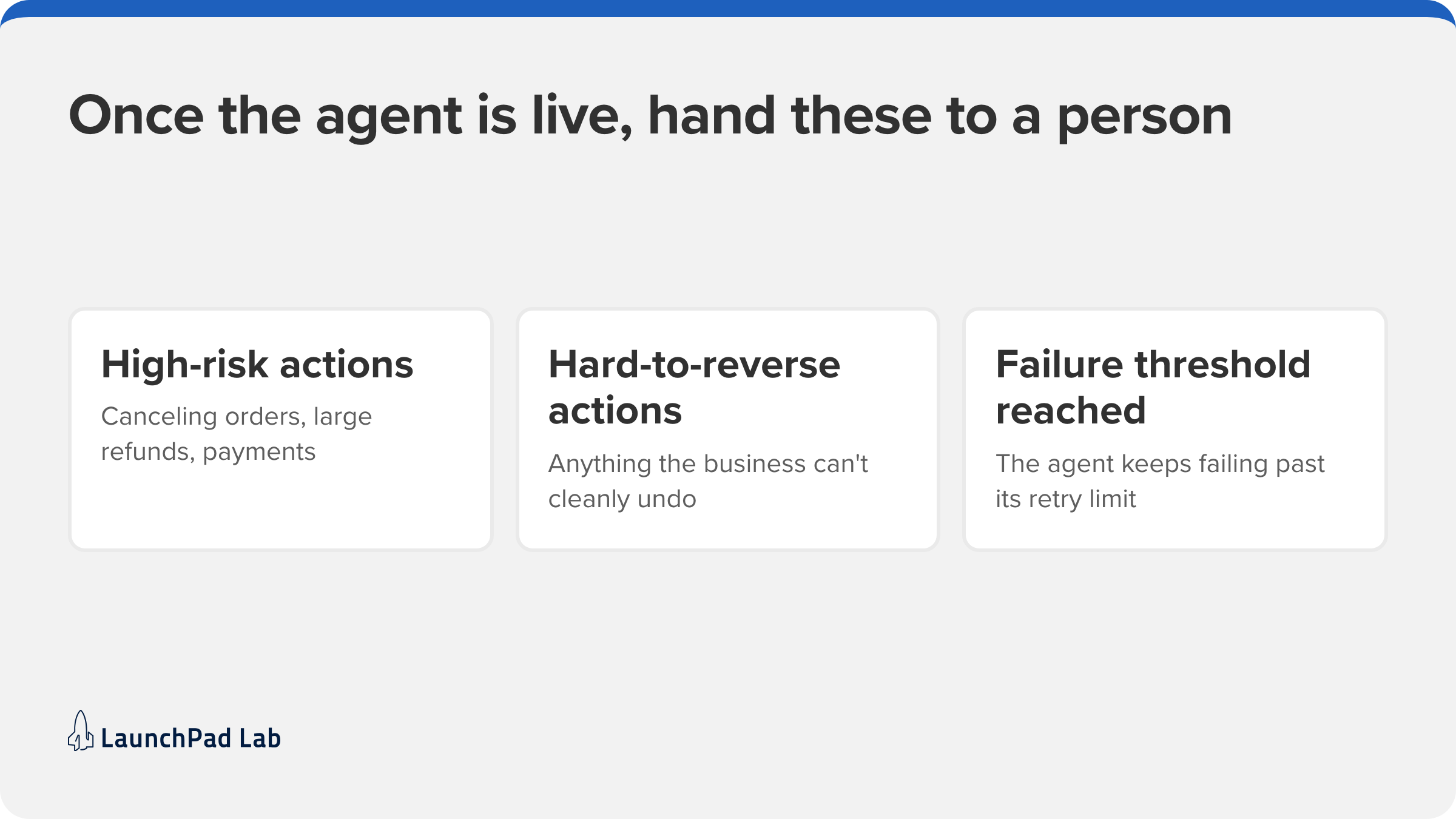
Keep a person reviewing any action that is high-risk or hard to reverse, such as canceling orders, issuing large refunds, or making payments. OpenAI’s agent-building guide names two triggers for handing control to a person: exceeding failure thresholds and attempting a high-risk action.