
Picking an agent framework feels like a one-time decision. It rarely stays that way. Several iterations later, your orchestration layer is tangled up with your evaluation suite, your logging, your deploy pipeline and the people you hired to run it. The question stops being which of the agentic AI frameworks is best. It becomes which one you can still afford to leave.
Almost every guide to this topic is published by a company that sells one of these frameworks, or by a reference site that will never maintain the result. At LaunchPad Lab we pick these tools on client budgets and then live with them for years. That gives us the view these guides tend to miss: what the choice looks like a year in, when leaving it has a price.
So you get a default worth starting from, and a straight account of the conditions that make it the wrong one.
TL;DR
- An agentic AI framework’s real job is control flow: state, retries, approvals and failure handling.
- Microsoft folded AutoGen and Semantic Kernel into one Agent Framework. AutoGen builds face a migration.
- Seven AI agent frameworks matter now: LangGraph, LangChain, CrewAI, Microsoft Agent Framework, LlamaIndex Workflows,
- OpenAI Agents SDK, ReAct.
- Open source shifts cost into observability, evaluation, upgrade churn and on-call. It does not remove it.
- Default to LangGraph for production Python. .NET shops start with the Microsoft Agent Framework.
What does an agentic AI framework actually do?
An agentic AI framework is the software layer that turns a language model into a system that does work. It handles planning, memory, tool calls, retries and the control flow between steps. The model decides what to do next. The framework decides what happens when that decision is wrong, takes too long, or needs a person to sign off.
One thing we noticed: three different products get sold under the same umbrella.
- A framework gives you abstractions and control flow, and you host it yourself. LangGraph and CrewAI sit here.
- An SDK is a thinner client over one vendor’s models and tools. The OpenAI Agents SDK sits here.
- A platform is hosted, with a console, connectors and governance built in. Salesforce Agentforce sits here.
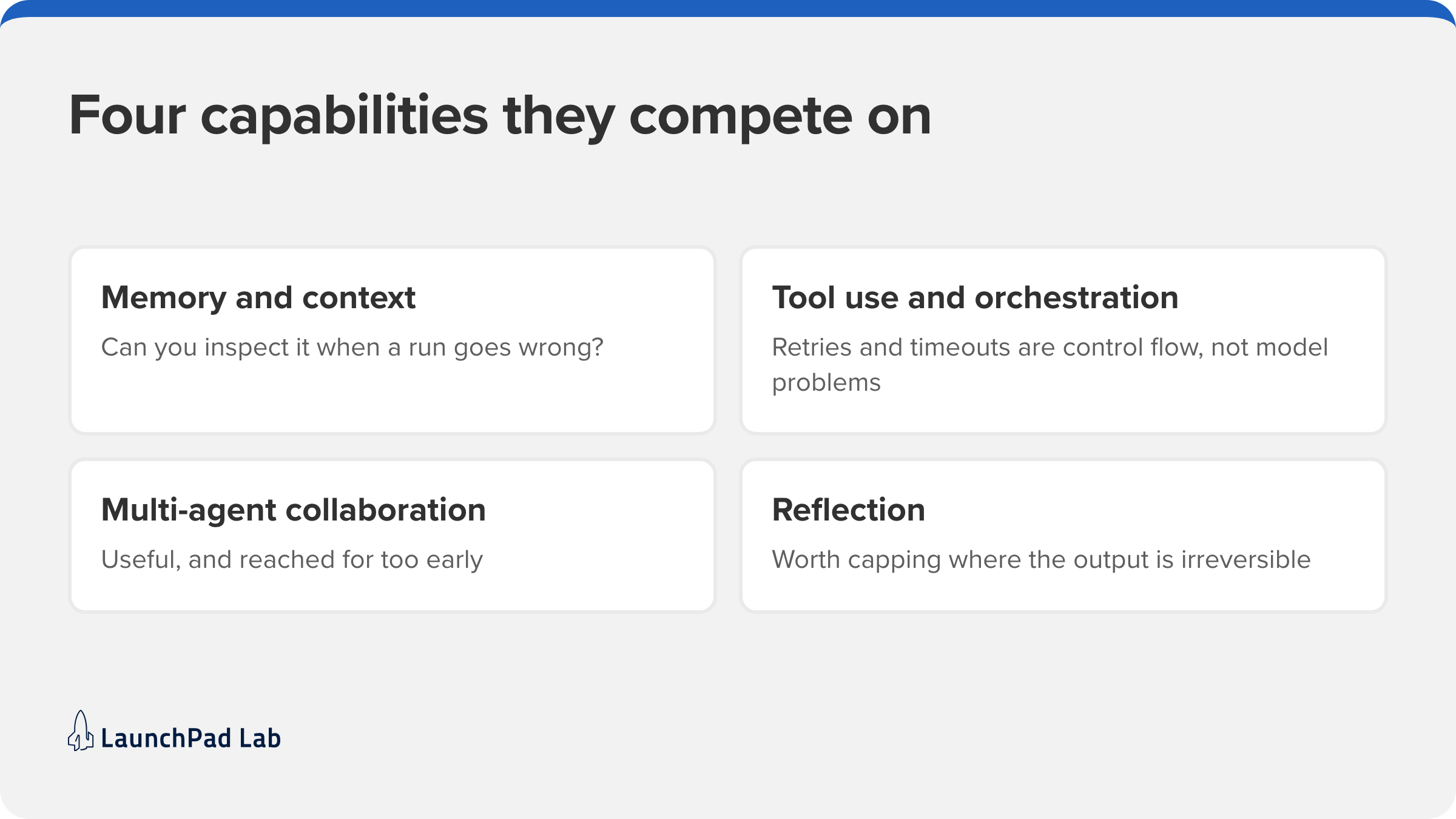
Once you know which type you are buying, four capabilities decide which product inside that type fits. Every vendor claims all four. The questions below are what separate the claim from the implementation.
1. Memory and context
Memory lets an agent carry state across steps without re-reading everything each time. It splits into short-term working context and a longer store, usually a vector database or plain database rows.
Every framework has memory. What matters is whether you can inspect it when a run goes wrong; that is what turns a two-hour debug into a two-day one.
2. Tool use and orchestration
Tools are how an agent changes something outside the chat window: a database write, an API call, a file.
Orchestration is the control flow around those calls. Retry policy, timeouts and partial failure are architecture decisions, and no model upgrade fixes a weak one. This is where the frameworks differ most.
3. Multi-agent collaboration
Some work splits cleanly across several specialized agents that hand off to each other, supported by roles, shared scratchpads or message passing. It earns its keep on research and drafting.
It is also the feature teams reach for too early, when one agent and three good tools would have shipped sooner and cost less to run.
4. Reflection and self-correction
Reflection is an agent checking its own output and trying again. It improves quality on open-ended work, and it spends tokens and latency on every loop.
Turn it on when the output is a draft. Cap it hard where the output triggers something you cannot undo, such as a payment or a customer email.
What are the top agentic AI frameworks in 2026?
1. LangGraph
LangGraph models an agent as a graph of steps with explicit routes between them, so the workflow is a state machine you can read rather than a loop you have to trace. It saves state after every step, which means a run that fails at step nine resumes at step eight instead of starting over.
Best for long-running work with branching and human approval. It costs a steeper learning curve.
Skip it for a single model call with two tools.
2. LangChain
LangChain is the older, broader library: model wrappers, retrievers, output parsers and hundreds of integrations. It remains the fastest way to get a component without writing the glue yourself.
It costs you churn: the library moves fast, its surface is wide, and teams regularly report spending more time tracking breaking changes than building.
Skip it as your orchestrator. Most teams now use it as a component library beside LangGraph rather than as the orchestrator.
3. CrewAI
CrewAI organizes work as a crew of role-playing agents: a researcher hands to a writer, who hands to an editor. The metaphor is intuitive and the path to a working demo is short, which is why it spreads fast inside teams. It costs you control.
The moment a workflow needs conditional branching or a human interrupting mid-run, the role metaphor fights you. Good for prototypes.
4. AutoGen and the Microsoft Agent Framework
AutoGen pioneered conversational multi-agent patterns, where agents solve a problem by talking to each other. That lineage now lives in the Agent Framework. It is the strongest option once your organization runs .NET or Microsoft 365, because session state, type safety, middleware and telemetry arrive as defaults rather than as project work.
It costs you gravity toward one vendor. Skip it if portability is a hard requirement.
5. LlamaIndex Workflows
LlamaIndex Workflows come from the retrieval world and it shows. When the hard problem is documents, splitting them into retrievable pieces and getting the right ones in front of the model, this is the shortest path to good answers. It costs you breadth: as general orchestration it is thinner than LangGraph.
Choose it when retrieval quality is the project rather than a supporting detail.
6. OpenAI Agents SDK
The OpenAI Agents SDK is deliberately small: agents, handoffs, guardrails and strong tracing, with little ceremony. For teams already committed to OpenAI models it removes a lot of scaffolding. It costs you portability, because the happy path assumes one provider.
Choose it when you want something in production this month and vendor neutrality is not a requirement.
7. ReAct, and why it is a pattern rather than a framework
ReAct is a prompting pattern, not a product, and you cannot install it. It comes from a 2022 paper by Yao and colleagues describing a model that alternates between reasoning and acting, with each observation shaping the next step.
Every framework above implements a version of it. Know it because it explains agent behavior, and keep it separate from React, the JavaScript UI library, which shares only the name.
How the top agentic AI frameworks compare
This comparison table outlines the strengths, best use cases, and potential trade-offs of today’s leading frameworks:
| Framework | Best for | Runtime | Strength | Main limitation |
| LangGraph | Stateful production workflows | Python, JavaScript | Explicit state machine, resumable runs, human-in-the-loop | Steeper learning curve, more verbose |
| LangChain | Components and integrations | Python, JavaScript | Very large integration library | Broad surface area, API churn |
| CrewAI | Role-based prototypes | Python | Fast to a working demo, intuitive model | Weak fit for branching or interruption |
| Microsoft Agent Framework | Enterprise .NET and Microsoft 365 | .NET, Python, Go (preview) | Session state, type safety, telemetry | Pulls you toward one ecosystem |
| LlamaIndex Workflows | Document and retrieval-heavy agents | Python, TypeScript | Strongest retrieval and indexing | Thinner as general orchestration |
| OpenAI Agents SDK | Fast builds on OpenAI models | Python, JavaScript | Minimal ceremony, strong tracing | Assumes a single model provider |
| Salesforce Agentforce | Agents inside Salesforce data | Hosted platform | Native identity, records and governance | Not portable outside Salesforce |
Agentic AI frameworks vs chatbot development frameworks: how do they differ?
A chatbot framework manages a conversation: turns, intent and state, so a user gets a useful reply.
An agentic framework manages a task that changes data in other systems.
The practical difference is blast radius. A chatbot that misunderstands gives a bad answer. An agent that misunderstands writes to your CRM.
That difference drives engineering. Chatbot frameworks invest in dialogue management, fallback handling and channel integrations. Agent frameworks invest in control flow, tool schemas, retries and audit trails.
It changes how you measure success too:
- A chatbot is judged on containment and user satisfaction.
- An agent is judged on task completion and cost per completed task.
- Both matter less than how often a person had to step in and undo something.
Teams get this wrong when a support bot already exists and the new requirement looks adjacent. It usually is not. The moment the requirement includes “and then update the record,” you are building an agent, and you need the permissions, logging and rollback story that comes with one. Our guide to what an AI agent is draws the line in more detail.
Which agentic AI frameworks are open source?
LangGraph, LangChain, CrewAI, LlamaIndex, Semantic Kernel and the OpenAI Agents SDK are all open source under permissive licenses, typically MIT or Apache 2.0. Agentforce is the exception, hosted end-to-end. The paid layer sits alongside rather than inside: LangSmith for tracing, LangGraph Platform for deployment and the vendor consoles all carry commercial terms.
Open source AI agent frameworks buy you three things that matter at enterprise scale. You can read the control flow and patch it.
You can pin a version so an upstream change cannot break production overnight. And you can run the whole thing inside your own network, which is often the deciding factor under HIPAA, SOC 2 or a data residency rule.
What it does not do is remove cost. It moves the cost onto your team, in four places:
- Observability. You need traces, token accounting and a way to replay a failed run.
- Evaluation. Without a regression suite you cannot tell whether a prompt change helped. Agents drift quietly.
- Upgrade churn. These libraries move fast. Pinning is safe and slowly makes you the maintainer of a fork.
- On-call. Someone has to understand the orchestration layer at 2am. That is a hiring decision as much as a technical one.
Budget for those four and open source is usually the right call. Skip them and the licence saving disappears inside the first year.
How do you choose an agentic AI framework for production?
Start from your constraints. They eliminate options faster than features do. Four questions settle most of it. What runtime does your team already run? Does the workflow need to pause and resume? Is retrieval the hard part? And who has to audit the result?
Answer those honestly and the shortlist is usually two.
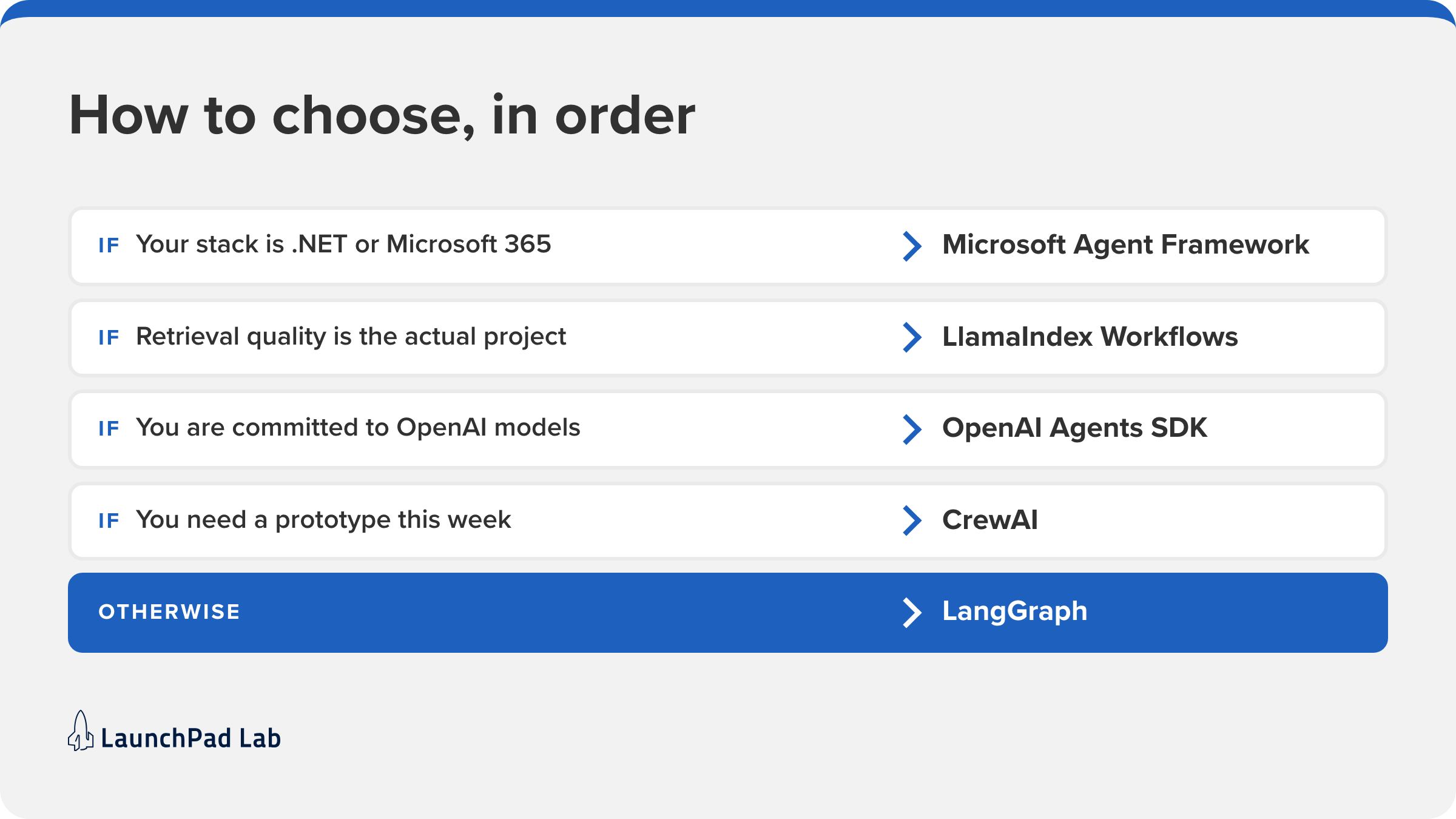
Then apply the rule:
- If your stack is .NET or Microsoft 365, start with the Microsoft Agent Framework. Ecosystem fit beats a marginal capability advantage almost every time.
- If retrieval quality is the actual project, start with LlamaIndex Workflows and add orchestration later.
- If you are committed to OpenAI models and want something running this month, use the OpenAI Agents SDK.
- If you need a prototype in front of stakeholders this week, use CrewAI, and expect to revisit it.
- Otherwise, use LangGraph. Explicit state, resumable runs, and a control flow you can reason about when something fails at 2am.
One question belongs before all five. Does this workload need an agent at all? Microsoft’s own Agent Framework documentation is blunt about it: if you can write a function to handle the task, write the function. A deterministic pipeline you can test beats an agent you have to supervise.
If the decision needs an outside read, that is what our AI consulting engagements are for: a week spent pressure-testing the choice against your real workload, before it gets expensive to revisit.
Where to start
Pick the default and move. Of the agentic AI frameworks covered here, LangGraph is what we would choose for production
Python work today. Your compliance regime or your existing platform can overrule that, and in both of the builds above they did.
Then scope the work around the framework before you start, rather than after it is running. Observability, an evaluation suite and a named owner for the orchestration layer are what decide whether this choice still holds up in a year. Teams that price those in at the start are the ones who never have to rebuild.
If you are weighing this against a real workload rather than a demo, we can pressure-test the choice with you and build on the answer. Talk to our team about AI agent development.
Frequently asked questions
What is the best framework for agentic AI in production?
For most teams building production agents in Python, LangGraph is the safest starting point, because it saves state at every step and a failed run resumes instead of restarting. There is no single best answer, but there is a defensible default. Two conditions change it: choose the Microsoft Agent Framework if your stack is already .NET or Microsoft 365, and CrewAI if you need a prototype this week.
What is the difference between LangChain and LangGraph?
Two libraries from the same team doing different jobs. LangChain is the component library: model wrappers, retrievers, parsers and hundreds of integrations you assemble yourself. LangGraph is the orchestrator, modeling an agent as explicit steps and routes so a run can branch, pause for approval and resume after a failure. Most production teams now use both, with LangGraph controlling flow.
Do you need an agent framework at all?
Often not. Microsoft’s own guidance advises that if you can write a function to handle a task, do that instead of using an agent. One model call with two tools needs no orchestration layer. We shipped a HIPAA-compliant document-processing system on a plain job queue, expected to reach 85 to 90% determination accuracy, because auditability mattered more than abstraction.
What does it cost to migrate between agent frameworks?
The framework code is rarely the expensive part. Four things move with it: tool integrations, your evaluation suite, observability wiring and the knowledge sitting in your team. Model Context Protocol has made the first substantially cheaper, because integrations written to the protocol are portable. Budget for the other three, and expect the evaluation suite to take longest to rebuild.