
You have a shortlist of the best app development firms. It came from a directory, a colleague, or an hour of searching, and every agency on it looks capable. The portfolios are polished, the client quotes are warm, and the process diagrams all show the same five stages. None of that tells you which one will still be useful in month nine, which is what you actually need to know. Very little written about choosing an app development firm helps with that part.
Many guides on this topic explain what these companies do and then list the biggest ones. We’re writing from our experience as an app development partner: LaunchPad Lab has worked with more than 250 clients since 2012, and we’ve also been hired to fix what a previous agency left behind.
By the end, you should be able to tell from one sales call whether a team has done work like yours or is only describing it well.
TL;DR
- Every portfolio looks good. Judge an app development firm on what happens after launch: who owns the code, who fixes it when it breaks, and who will tell you no.
- Four things decide it, roughly in this order: strategic thinking, experience in your sector, a visible process, and a real support commitment.
- The clearest warning sign is a price quoted before anyone has asked what the software has to do.
- A freelancer is the right answer more often than agencies admit, usually when the scope is small and already specified.
- Cost depends on scope, platform count, integrations, and compliance, so any number quoted before discovery is guesswork.
Why the right app development firm matters
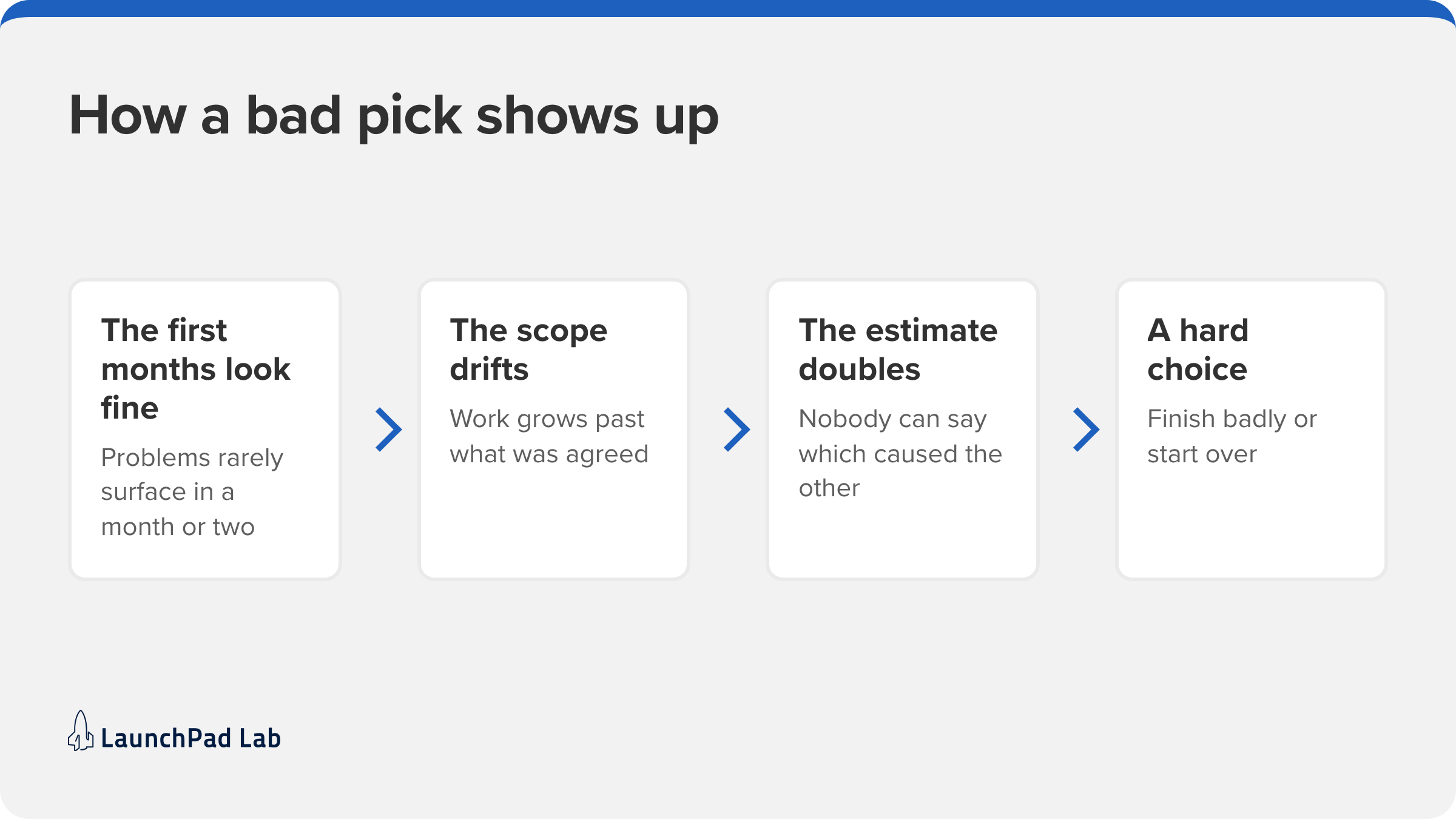
The bill for a bad pick usually arrives late. Projects that go sideways rarely announce themselves in a month or two. They show up later, when you do not expect them. The scope drifts, the estimate doubles, and nobody can say which caused the other. By then you’re choosing between finishing badly and starting over.
That’s why it pays to know how to choose an app development partner before any engagement starts.
The problem is also common. In a 2024 BCG survey of C-suite executives across 25 industries, nearly half said more than 30% of their organization’s technology development projects ran over budget and late. The same research found a 154% higher success rate when technology leaders shaped the strategy from the start, which is something you can ask about during selection.
The same applies to AI. Plenty of agencies now offer AI features, but designing custom AI software into the product from the start is very different from adding it at the end.
What does an app development firm actually do?
An app development firm is a company that designs, builds, and maintains custom software for web browsers and mobile devices. The work usually runs from discovery and product strategy through UI and UX design, engineering, quality assurance, launch, and post-launch support. Nearly every agency offers all of that, so the service list won’t separate one from another.
What separates them is where their work stops and yours begins.
That boundary decides who owns the product, who pays for changes, and who you call when something breaks. Left alone, it gets settled in the first two weeks in whatever way suits the vendor, so decide it on purpose in four places:
- Product decisions. Who decides what goes in release one? If the answer is the agency, you’ve outsourced your roadmap.
- API and integration ownership. Connecting to your CRM, billing system, or data warehouse is where projects lose months, and an API contract nobody owns turns into an argument later.
- Quality assurance. An outside team testing its own work is normal. Letting it also define “done” is how the bar drifts toward whatever passed.
- Post-launch support. It’s the part people put off and the part that costs more than anything else over time, so settle it before anyone writes a statement of work.
Once you know which parts you’re handing over, the next question is what kind of app you need. We run web application development and mobile app development as separate practices, because the skills overlap less than people expect.
Web vs mobile app development services: what to choose?
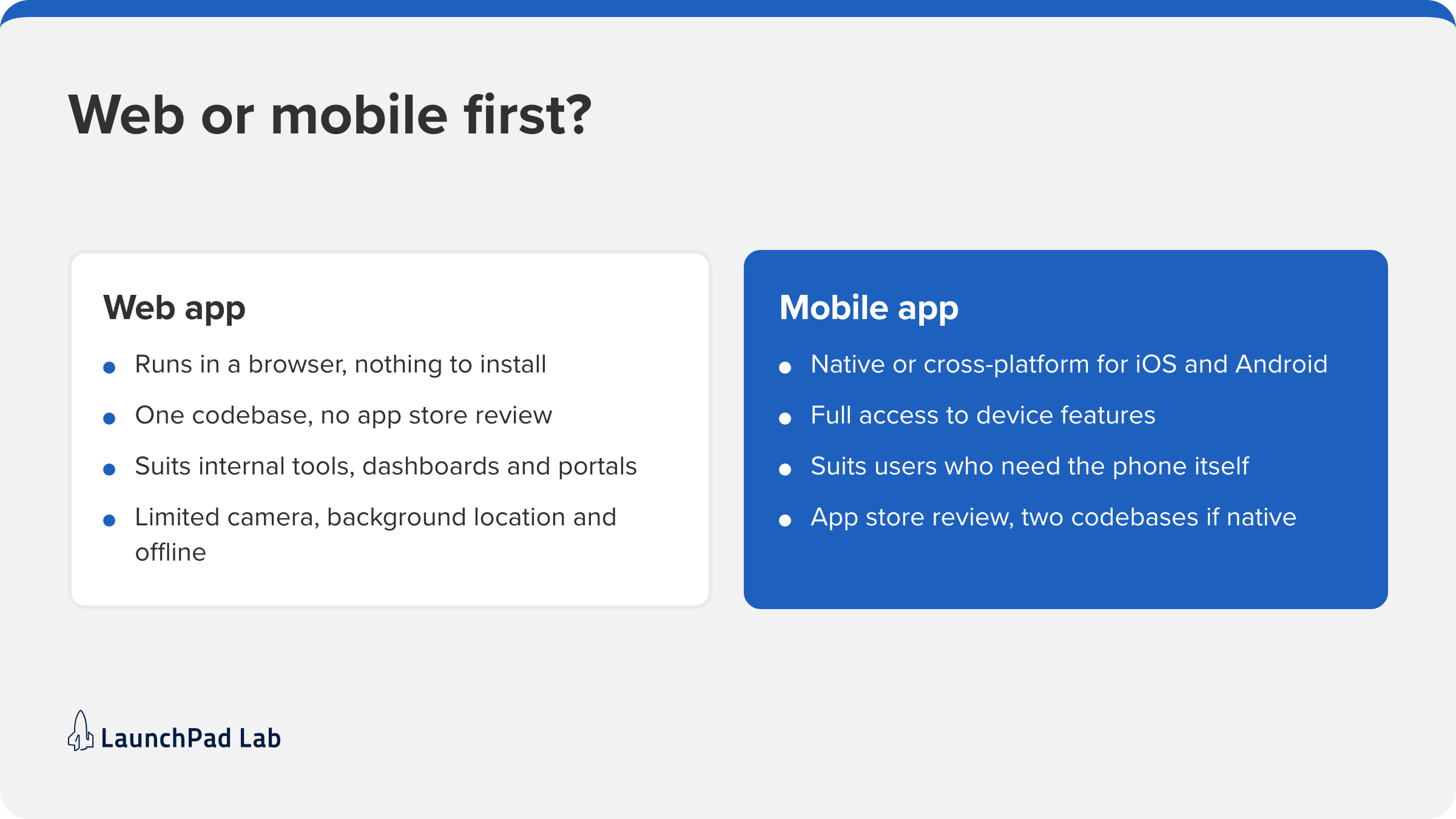
In many cases, where your users already live settles this decision. Both options are usually possible, so the question is which one earns its value first. Ask any agency which one they would build first and why, and listen for whether the answer is about your users or their preferred tools.
Why choose web app development?
Web apps run in a browser, so there’s no install, no app store review, and only one codebase to update. That makes them the usual choice for internal tools, admin dashboards, and customer portals.
The trade-off is that browsers limit what you can do with the phone itself, such as using the camera, tracking location in the background, or working offline. If your app depends on any of those, plan for mobile.
Why choose mobile app development?
Mobile means native or cross-platform. Native builds separate apps in each platform’s own language for iOS and Android, which gives the best performance and immediate access to new OS features. Cross-platform frameworks like Flutter and React Native share one codebase across both, which cuts build time and cost, though they can lag behind new platform features.
For many mid-market products, cross-platform is the right starting point, and a small first release beats a big one. A minimum viable product in users’ hands this quarter teaches you more than a full launch six months later. Ship an MVP to a small group first and let them shape the next release.
As an example from our own work, we built Northern Solar‘s customer app cross-platform on Ionic. The framework mattered less to the result than getting the app to customers early without complications.
How do you choose an app development partner?
When you talk to agencies, four things tell you whether you’ve found a partner worth hiring. Do they think before they build, do they know your sector, is their process visible, and will they stay committed after launch? Check them in that order, because the earlier ones usually predict the later ones.
| What to evaluate | Ask for | A good answer | A bad answer |
| Strategic thinking | Pushback on your own scope | Names a requirement they would cut, and why | Agrees with everything in the first meeting |
| Sector experience | A project in your industry | A constraint they hit and designed around | A logo wall and a list of verticals |
| Process | Their last missed deadline, and how the client heard | A named person and a fixed reporting schedule | A process diagram |
| Post-launch support | Response times and who is on call | Hours and a response window in the contract | “We are always here if you need us” |
1. Strategic thinking before the first line of code
The clearest signal in a sales call is whether anyone pushes back on you. If your whole scope gets a yes in the first meeting, nobody is really listening. You want people who ask what happens if this ships late, who the software is replacing, and which requirements are true constraints and which are preferences. This is your indicator that you are working with a partner who can help your business.
Apex Leaders shows why this matters. They came to us after two previous agencies had failed on the same project. Booking a single call with them took 20 to 25 minutes of phone calls and emails. We built an advisor portal with self-service scheduling, and it now takes 2 to 3 minutes.
2. Industry expertise in your sector
Sector experience means knowing your non-negotiable constraints before they turn into expensive rework. Experience in healthcare means building role-based access and audit trails into the architecture from day one. Experience in financial services means knowing what a compliance review will ask for.
Before the call, read a case study from your industry, and check the agency’s Clutch profile for verified client reviews with project size and duration.
3. Process and transparency
At any point in the project, you should know what’s being worked on and what’s running late. Good agencies make this routine with a shared board, a regular demo, and a named person who flags problems early.
4. Post-launch support and iteration
This is where many engagements quietly fall apart, because nobody prices it while everyone is excited about the build. Operating systems update, dependencies break, and the first month of live use always creates work nobody planned for. Ongoing support and enhancement belong in the same contract as the build, not a separate conversation after launch.
6 red flags to watch for in an app development firm
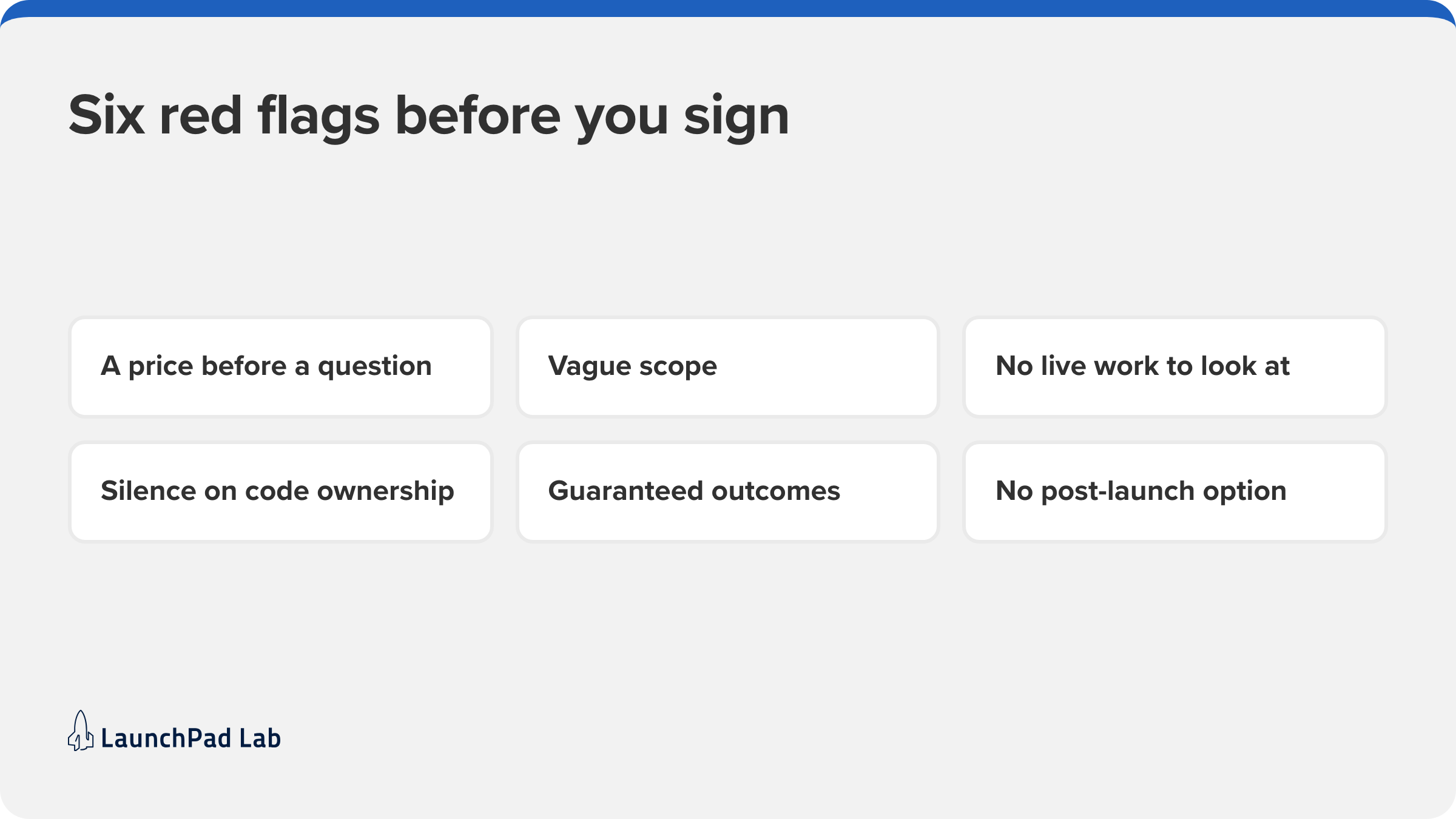
None of these warning signs rules an agency out on its own. They all show up before a contract exists, though, which makes them useful, and two of them in a single conversation is worth taking seriously. Listen for them in the first two calls.
- A price before a question. Quoting a number before understanding what the software has to do means quoting for an average project, and yours isn’t average.
- Vague scope, or reluctance to write a detailed statement of work. The statement of work is where the disagreement you’d otherwise have in month six gets settled up front.
- No live work to look at. Case studies are marketing. Ask for apps you can open in the App Store or a browser, and ask which parts the team actually built.
- Silence on code ownership. You should own the code, the repository, and the infrastructure accounts, in writing. Otherwise, the cost of leaving is out of your hands.
- Guaranteed outcomes. Download numbers, user growth, or a fixed launch date before discovery. Nobody can promise these, so a promise tells you how the agency behaves when it doesn’t know something.
- No post-launch option. Someone needs a plan for year two before you sign.
We sometimes get brought in after these signs were ignored, and usually nobody had written down what the software needed to do before building started. AlgoFast was one of those projects, with an offshore-built codebase their own developers couldn’t safely extend. We refactored it and trained their developers to maintain and extend it themselves.
6 questions to ask before you hire an app development firm
Ask these in the first call, and grade the answers instead of just collecting them. You’re listening for specificity: a project, a number, or a name. General answers are the warning sign, and the questions on code ownership and year-two support deserve the closest listening.
- Can you show me something you built in my industry, and tell me what went wrong with it? A good answer names a real problem and what they changed. An answer with no failure in it is a case study being read aloud.
- Who owns the code, the repositories, and the cloud accounts? The only good answer is that you do, from day one, in writing.
- What does your discovery phase produce? You want a defined artifact: a scoped backlog, wireframes, an architecture decision, a revised estimate. “We get to know your business” is not a deliverable.
- Who is actually on my team, and what else are they working on? Ask for names and allocation. Agencies win with senior people and staff with junior ones more often than they’ll admit.
- How do you handle testing, and what does done mean? You’re looking for a written definition of done, plus automated coverage of the paths your users actually take.
- What does support look like in year two, and what does it cost? Response times, on-call arrangement, and whether the build team stays.
Run them against two agencies rather than five, since a third conversation rarely changes the answer. If you’re still putting a shortlist together, our roundup of leading app development companies is a good starting point.
What is the difference between an app development agency and a freelancer?
An agency gives you a team and continuity. A freelancer gives you one person and lower overhead. Both are correct answers to different questions, and agencies aren’t honest about this as often as they should be, since one of the options isn’t them.
| App development agency | Freelancer | In-house team | |
| Coverage | Design, engineering, QA, and PM under one contract | One skill set, usually engineering | Whatever you have hired for |
| Speed to start | Weeks, after scoping | Days | Months, if you are hiring |
| Continuity risk | Low, the team absorbs a departure | High, one person is the whole project | Medium, depends on documentation |
| Cost shape | Higher rate, fewer surprises | Lower rate, more of your time managing | Fixed cost that outlives the project |
| Post-launch | Contractual, with response times | Depends entirely on availability | Yours by default |
A freelancer is the right call when the scope is small, already specified, and needs no design or QA around it. Think of a defined integration, one feature, or a throwaway prototype. Once the work needs more than one discipline at a time, you end up as the project manager.
The in-house column is the one people skip. If this software will run your business for the next five years, the honest long-term answer may be to build the team and use an agency to get there faster. For scale, we shipped Digital Dental Solutions‘ HIPAA-compliant portal in under three months.
How much does it cost to hire an app development firm?
The cost depends on what the app has to do, how many platforms it runs on, and how much it connects to. We don’t quote rates here, and any number handed to you before discovery is guesswork, but the same factors move the total every time.
- Complexity and features. Real-time collaboration, push notifications, offline mode, secure login, and admin dashboards each add development and testing time.
- Platform and tech stack. Native iOS and Android means two codebases to build and maintain, and cross-platform narrows that gap without closing it.
- Custom design. Design built around your users costs more up front and usually pays back in adoption.
- Backend and integrations. Connecting to Salesforce, a legacy system, or any other API adds work, and older systems with no modern API add the heaviest load.
- Compliance. HIPAA is the common one. The HHS Security Rule requires administrative, physical, and technical safeguards, and HHS proposed strengthening it in January 2025.
How you build matters as much as what you build. Off-the-shelf and low-code tools are cheaper for a simple internal tool or an early MVP, but they get harder to adapt as you grow. Custom development costs more up front and gives you full control. Budget for support, hosting, and new features after launch too.
Pay for the estimate separately from the build: a fixed-scope discovery gives you a firm number and a plan. AI-assisted delivery has also made writing code cheaper relative to deciding what to build, which is why our Nova delivery model prices outcomes rather than hours. For typical budget ranges by project size, see our guide to the cost to develop an app.
How we approach app development at LaunchPad Lab
We’ve built 760+ projects since 2012, hold a 4.8 out of 5 rating on Clutch with several Clutch Global Awards, and keep 90% of clients past their first year. We watch that retention figure closely, because it shows how the relationship holds up after launch.
One project we point to often is CDK Global. Their sales team had run discovery on pen and paper for about 25 years, and training a new rep took over a year. We built a tablet app that guides reps through discovery and syncs with Salesforce in real time, and training now takes about a day.
What to do next
Grade the answers on specificity. Look for the app development firm that names a real failure, puts code ownership in writing, and treats support as an arrangement. That is usually the one still doing good work for you in year two.
If you want the estimate before the commitment, ask for a scoped product strategy engagement and pay for it. It’s the cheapest test of a working relationship available; you keep the plan whichever agency you choose, and it costs a great deal less than two months of the wrong decision. If you’d like a second opinion on your shortlist, talk to our team.
Frequently asked questions
How do you find a reliable partner for mobile app development?
Start with proof you can open: apps in the app store, verified reviews on a directory like Clutch, and a case study in your sector. Then run one call that covers code ownership, discovery, staffing, and year-two support, with ownership and support weighted highest.
Which development partners are best for building secure multi-user business platforms?
Look for teams that can explain how they keep each customer’s data separate, who can see what, and how that holds up under load. Ask what happened when a system they built hit a traffic spike. We rebuilt NextLot, for instance, to absorb bid surges up to 100 times normal volume. It has cleared more than $2B in annual transactions without dropping bids.
What does an app development firm do after launch?
Monitoring, bug fixes, dependency and operating-system updates, security patches, and the feature work that actual usage produces. Get response times and an on-call arrangement in writing, and confirm whether the people who built it are the people maintaining it. For anything that stops people working, a response window measured in hours, such as four business hours, is a reasonable ask.
How long does it take to build an app?
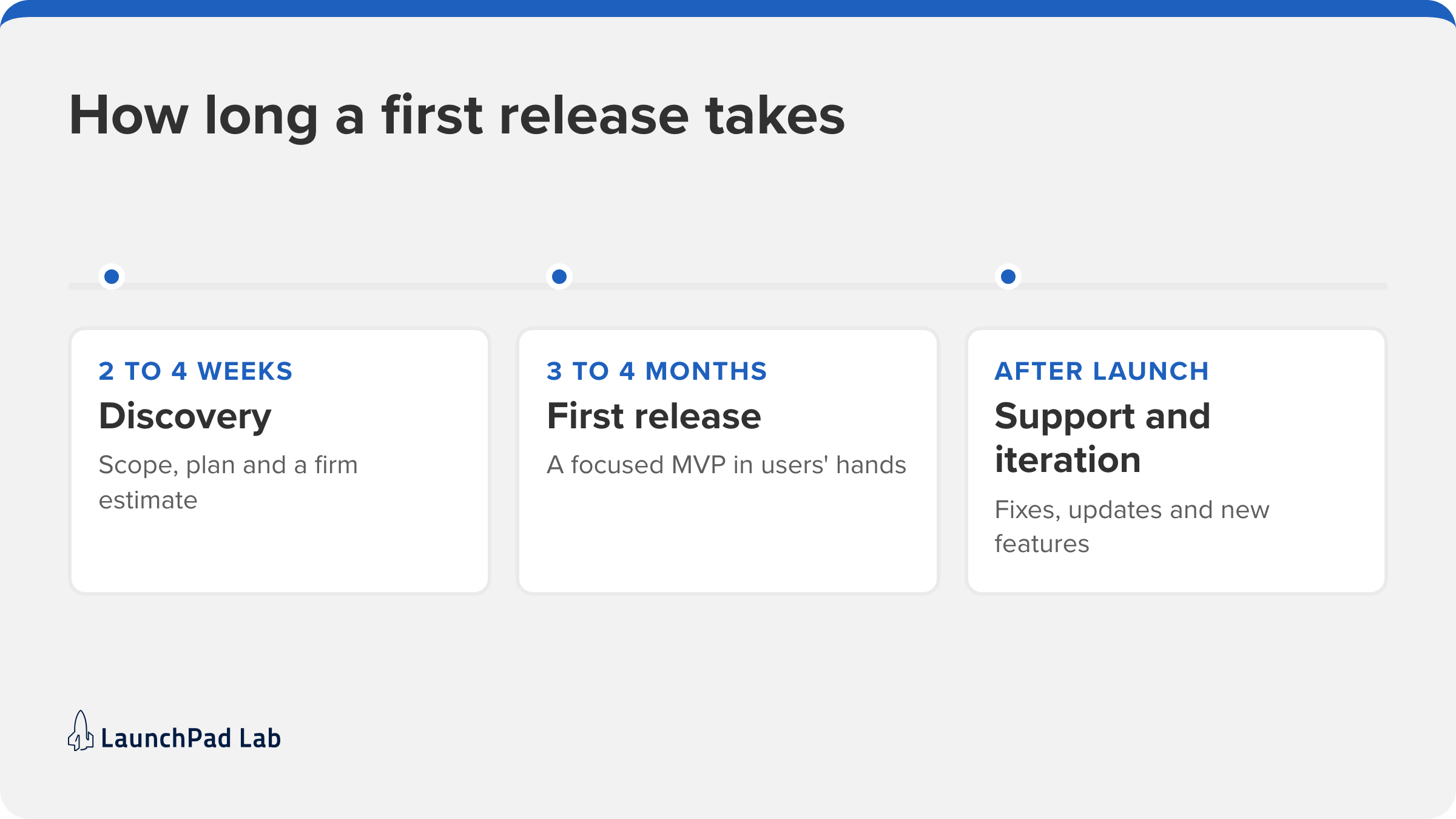
For a focused first release, three to four months is realistic, and we’ve taken a production platform live in eight weeks. Multi-platform launches and heavy integration work push it past six months. Discovery adds two to four weeks up front and usually saves more than that later.