
Plenty of AI agents look great in the demo. But many don’t shine quite as bright when they have to make actual contact with real users, messy data, and the systems your business already runs on. The gap between the two usually comes down to architecture.
Gartner predicts that more than 40% of agentic AI projects will be canceled by the end of 2027. Its report cites rising costs, unclear business value, and weak risk controls as the main reasons for this. Most of that failure isn’t about the model. It’s about how the agent was built.
AI agent architecture is the structural blueprint for how an agent takes in information, makes decisions, remembers what matters, and acts to reach a goal. You may also hear it called agentic AI architecture (and we’ll use both terms throughout the article). Get your architecture right, and your agent holds up under pressure. Get it wrong, and it quietly falls apart the moment things get complicated.
What Is AI Agent Architecture?
AI agent architecture is the structural blueprint for how an AI agent:
- perceives its environment
- reasons about what to do
- remembers what it learns
- acts to reach a goal
Agentic AI architecture means the same thing; it’s just the phrasing you’ll run into more and more as the field matures.
It helps to think of it less as a single piece of software and more as the wiring that connects several moving parts:
- the model that does the thinking
- the memory that holds onto context
- the tools the agent can reach for
- the rules that keep it on track
When building an AI agent, the architecture is an important decision to think through, and should be made early. It will determine how the working parts of the system fit together, and hand work off to each other. And those choices largely determine whether the agent holds up once it’s deployed and handling real work.
AI Agents vs. Traditional Automation
It’s worth being clear early on about what actually makes an agent an agent. Traditional automation follows a fixed script. You define the rules up front (if this, then that) and the software runs the same predetermined steps every time. It’s reliable and predictable, which is exactly what you want for a task that never changes.
An AI agent works a little differently. Rather than following a script, it’s given a goal and the means to pursue it. It can weigh options, pick which tool to use, adjust when something unexpected comes up, and decide what to do next based on what it finds. That flexibility is the whole point, and the reason architecture matters so much. A rules-based workflow can only ever do what you told it to. An agent makes its own decisions, so the structure around it has to guide those decisions and catch them when they go sideways.
Core Components of an AI Agent Architecture
Most AI agent architectures are built from the same four components. How advanced each one is will vary from project to project, but knowing what each does is the simplest way to understand how an agent will behave and where it might break.
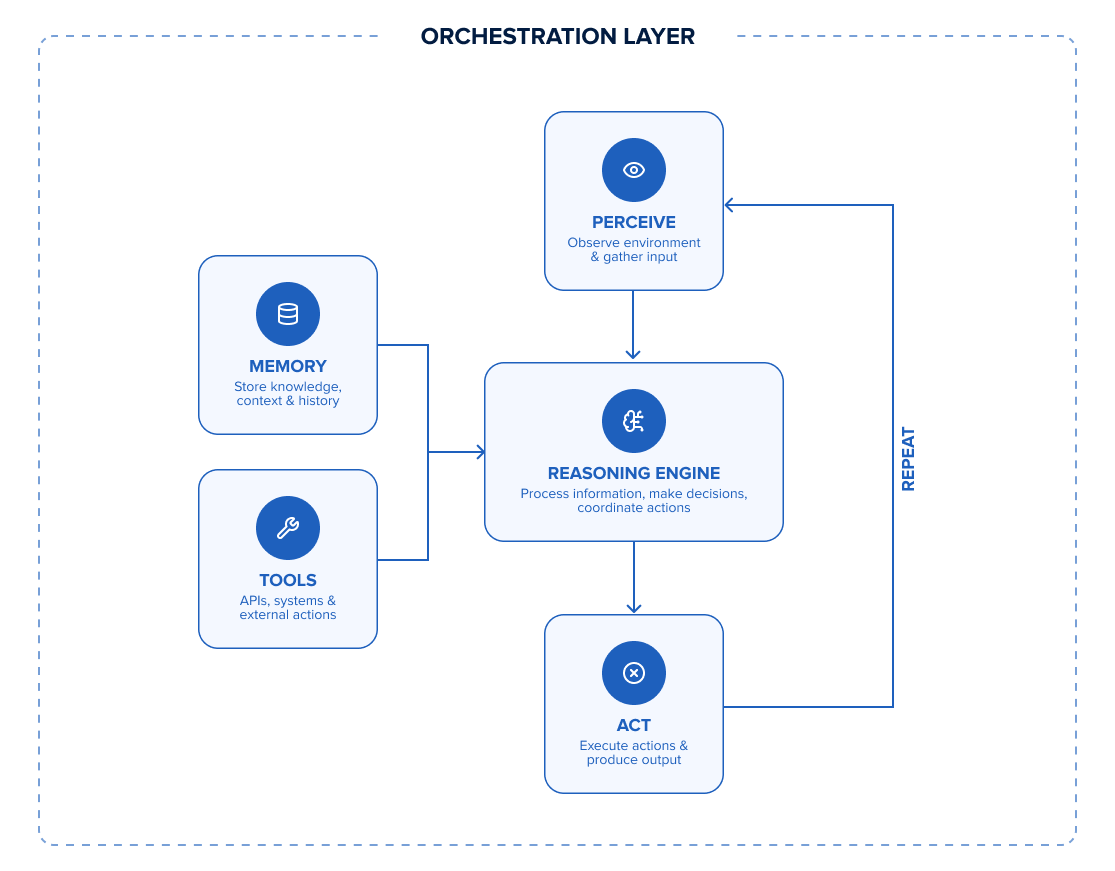
Reasoning Engine (the LLM core and planning)
This is the part that does the thinking. A large language model (LLM) interprets the goal, breaks it into steps, and decides what to do next. Planning is what turns “here’s what I want” into “here’s the order I’ll do it in,” and the quality of that planning sets the tone for everything else the agent does.
Memory (short-term context and long-term storage)
An agent needs to remember two different things. Short-term memory holds the current task and the steps taken so far, so the agent doesn’t lose the thread halfway through. Long-term storage keeps information across sessions, such as past interactions, documents, and learned preferences, usually in a database that the agent can search when it needs it.
Tools and Integrations
On its own, a model can only generate text. Tools are what let an agent do other things, such as look up a record, send an email, call an API, or update your CRM. Integrations connect the agent to the systems your business already runs on, which is usually where the real value lies, and where most of the engineering work goes.
Orchestration and Control
Orchestration is the layer that runs the show. It manages the flow between the other components, deciding when to call a tool, when to check memory, and when a task is finished, and it enforces the guardrails that keep the agent inside sensible boundaries. In a setup with more than one agent, it’s also what coordinates them so they don’t work on the same thing.
Common AI Agent Architecture Patterns
Most AI agent architecture patterns fall into one of three shapes. The one your AI agent needs will depend on how complex your task actually is, not on which one sounds the most impressive.
Single-Agent Architecture
One agent, one set of tools, handling the whole job from start to finish. It’s the simplest setup and, for most use cases, the right place to start. A customer support agent who answers questions, checks order status, and processes returns is a good fit: the work is contained, and a single agent can manage it without handing anything off.
Multi-Agent Systems
Here, the work is split across several specialized agents, usually with a lead agent that delegates to the others. Each one focuses on a piece of the problem and reports back. This works well when a task naturally breaks into parts that can run at the same time. For example, a market research job where separate agents dig into competitors, pricing, and customer reviews in parallel before the lead agent pulls the findings together.
Hybrid and Layered Architectures
Most real systems land somewhere in between the above two. A hybrid architecture might run one main agent for the bulk of the work and call in a specialized agent only for certain tasks, or stack agents in layers that each handle a different level of decision-making. The goal isn’t to use more agents; it’s to add structure only where it’s deemed necessary. An internal operations assistant that handles routine requests on its own but routes anything financial to a dedicated, tightly governed agent is a good example.
Single-Agent vs. Multi-Agent: Which Architecture Do You Need?
This is where the field of AI developers genuinely disagrees. Anthropic published How We Built Our Multi-Agent Research System, making the case that multiple agents working in parallel can outperform a single one on complex research. Around the same time, Cognition published Don’t Build Multi-Agents, arguing that handoffs between agents cause more problems than they solve. Both can be right; it just depends on the job you need your AI to do.
The practical takeaway for most teams is to start with one capable agent and strong tools, and add more agents only when the complexity of the task genuinely demands it. Multi-agent setups carry real risks. Context tends to get lost after just a few handoffs, since each agent only ever sees part of the picture. And a Google and MIT study found that independent multi-agent setups amplified errors by roughly 17x compared to a single agent, though that dropped to about 4x once a central orchestrator coordinated the work. So if you do go multi-agent, structure matters far more than the number of agents.
What to Plan for in Production
A prototype only has to work once, in a controlled demo. A production system has to work every day, on real data, inside the systems you already run. That gap is where most of the budget goes. And there are a few things worth planning for early:
- Memory and context degradation: Agents lose track of context over long tasks and many turns, so you’ll need a deliberate memory strategy to keep the agent from dropping important details halfway through.
- Integration with legacy systems: Connecting an agent to the tools and databases you already run on is usually the hardest, most time-consuming part of the build, and the part demos quietly skip.
- Governance and observability: You need to see what your agent is doing and why, with guardrails and logging in place, so you can catch problems before they reach a customer.
- Cost: Agents use far more computing power than a standard chatbot, and multi-agent systems even more. Confirm the value of the task justifies the spend before you scale.
How to Choose the Right Architecture for Your Use Case
There’s no single best architecture, only the one that best fits the job. A few principles to help guide your decision include:
- Start from task complexity: Map what the agent actually needs to do before you pick a pattern. Simple, contained work rarely needs more than a single agent.
- Match the pattern to the need: Reach for a multi-agent setup only when the task genuinely breaks into parallel parts. Otherwise, one capable agent with strong tools will serve you better.
- Design for modular components: Keep the reasoning engine, memory, tools, and orchestration as distinct parts, so you can upgrade any one of them without rebuilding the whole system.
- Plan governance early: Guardrails, logging, and oversight are far easier to build in from the start than to bolt on later.
If you’re weighing these decisions, it helps to start with the fundamentals: what an AI agent is and the practical side of building AI agents that hold up in production. LaunchPad Lab helps teams find the right opportunities first, then build, deploy, and scale AI agents that fit how they actually work. You can learn more about our AI agent development services and broader AI automation work.
FAQs
What is the difference between agentic AI and generative AI?
Generative AI creates content such as text, images, and code in response to a prompt. Agentic AI uses that ability to take action: it makes a plan, uses tools, and works toward a goal with little step-by-step direction. Put simply, generative AI answers; agentic AI acts.
What are the main types of AI agent architectures?
The three most common AI agent architectures are single-agent (one agent handles everything), multi-agent (specialized agents split the work under a lead agent), and hybrid or layered setups that combine the two. Most projects should start single-agent and add complexity only when the task calls for it.
Do I actually need a multi-agent system?
Usually not at first. A single capable agent with good tools handles most use cases, and it’s simpler to build, debug, and govern. Multi-agent systems make sense when a task clearly splits into parts that can run in parallel, and even then, a central orchestrator is worth having to keep errors in check.