Most teams don’t plan to implement a multi-agent system from the start. They add one AI agent at a time. One to handle support tickets, another to draft reports, a third to flag risky transactions. Each one works fine on its own. Then they start stepping on each other’s toes.
They duplicate work, make conflicting calls, and lose track of what the others already know.
This problem quickly compounds. Gartner predicts that by 2028, 33% of enterprise software applications will include agentic AI, up from less than 1% in 2024. As agents pile up, the hard part stops being whether any single one is capable. It becomes whether they can work together as a team.
That’s the job of AI agent orchestration: coordinating multiple agents so they share context, hand off work, and move toward one goal instead of pulling in different directions.
What Is AI Agent Orchestration?
AI agent orchestration is the practice of coordinating multiple specialized AI agents within a single system so they share context, hand off work, and act together toward a shared goal.
A simple way to think about it is:
- Agents provide the capability
- Orchestration provides the control
One agent might be good at research, another at writing, another at checking work for errors. On their own, they’re just separate tools. Orchestration is the layer you build in that decides who does what, in what order, and how they pass information along. You’ll also see this called agentic orchestration, or more simply agent orchestration. Same idea.
AI Agent Orchestration vs. AI Automation
This is the part that can start to get confusing and cause problems. AI agent orchestration and AI automation are two completely different things and serve very different purposes.
Traditional automation follows a script. You define the steps you want your AI to take, and the system runs them the exact same way every time, no matter what changes. AI agents work differently. They can make their own decisions, adapt to changes in inputs, and adjust outputs as context shifts. Automation does exactly what it’s told. An agent figures out what to do on its own.
Agent Orchestration vs. AI Orchestration
These two terms often get thrown around interchangeably, but they aren’t the same thing. AI orchestration is a broader practice of coordinating models, tools, and data pipelines so they work together. Agent orchestration is narrower. It’s specifically about coordinating autonomous agents, the ones that reason and act on their own. Put in a simpler way, agent orchestration is one piece of the bigger AI orchestration puzzle.
Why AI Agent Orchestration Matters
When agents run without orchestration, each one only ever sees its own part of the work. It makes a best guess, acts on it, and has no idea what the other agents are doing. This typically means you end up with duplicated effort, conflicting decisions, and a system that slowly works against itself.
A few signs tell you it’s time to coordinate things:
- A single task breaks into several specialized workflows
- Multiple triggers feed into one process
- You need tight control over which agents are allowed to take risky actions
That last one matters most in regulated work. In banking, healthcare, and telecom, an agent making the wrong call on its own isn’t just an issue that can be fixed. It’s a compliance problem.
How AI Agent Orchestration Works: Core Components
Under the hood, like any AI software, most orchestration setups are built from the same handful of parts. You won’t always build every one of them yourself, but knowing what each does makes it much easier to see where a system is working and where it’s likely to break.
The Orchestrator (control plane)
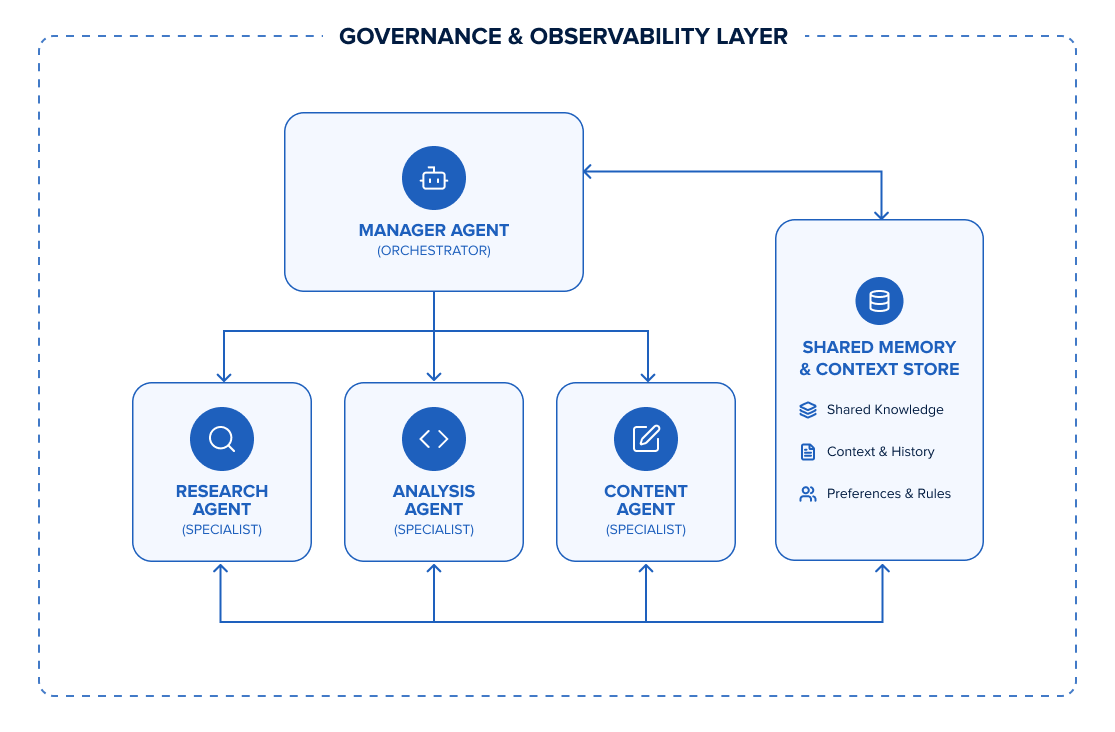
The orchestrator is the coordinating layer, and it’s where the control lives. Often it’s a “manager” agent that decides which agent runs, when, and in what order, then pulls the results back together. Some systems centralize all of that in one orchestrator. Others let agents coordinate peer to peer, with no single manager in charge.
Routing and Task Delegation
Once a goal comes in, something has to break it into steps and assign each one to the right agent. That’s routing and task delegation. The orchestrator splits up the work, sends each piece to the agent best suited for it, and manages the handoffs as one agent’s output becomes the next one’s input.
Shared Memory and Context
Agents need a way to pass along what they know. Shared memory and context is how information moves from one agent to the next, so whoever picks up a task has what the last agent already worked out. This is the part that breaks most often as systems grow. The more handoffs you add, the easier it is for context to get lost, until an agent down the line is working with half the story.
Communication and Protocols
For agents to work together, they need a shared way to talk, both to each other and to the tools they use. A few common standards are starting to make this simpler, like MCP (Model Context Protocol), which connects agents to tools and data, and A2A (Agent2Agent), which lets agents talk to each other. You don’t need the technical details. The point is that agents are starting to speak a common language, which makes it much easier to connect.
Governance and Observability
Governance and observability is what keeps the system safe and easy to debug. Governance is the permissions and guardrails: what each agent is allowed to do, and where it has to stop. Scope every agent to only what it actually needs. Observability is the logging and monitoring that shows what each agent did and why, so when something goes wrong, you can trace it back to the source.
Common AI Agent Orchestration Patterns
There’s no single way to wire agents together. Most AI agent orchestration patterns come down to how the work flows between them: one after another, all at once, through a manager, or with a person in the loop. The right one depends on how your task actually breaks down, not on which sounds the most advanced.
Sequential (handoff) Orchestration
One agent at a time, in a fixed order, each handing its output to the next. A research agent gathers the data, a review agent checks it, and a writer agent turns it into a draft. This is the right fit when the steps depend on each other, and where one step can’t start until the one before it is done.
Parallel (concurrent) Orchestration
Here, several agents work on different parts of the same task at once, and their results get merged at the end. Reviewing a contract is a good example: one agent checks it for legal risk, another for financial risk, and a third for compliance, all at the same time. It’s faster than handling each in turn, and it fits any task that splits cleanly into independent parts.
Hierarchical (orchestrator-led) Orchestration
A manager agent on top, handing subtasks to specialized sub-agents and pulling their work into the final result. A procurement agent might delegate to one agent that requests quotes, another that evaluates vendors, and a third that submits the purchase order. You see this most in larger systems, where one agent can’t reasonably hold the whole job on its own.
Human-In-The-Loop Orchestration
This pattern builds a human checkpoint into the flow. The workflow pauses for a person to review before it continues, usually at the high-stakes moments: anything involving money, access, or a customer-facing action. The agents still do the work, but a person signs off before the risky step goes through. For anything you can’t easily undo, it’s the safest default.
Centralized vs. Decentralized: How Much Coordination Do You Need?
Most of the orchestration questions come down to one choice: who’s in charge? In a centralized setup, a single orchestrator (a manager agent) routes everything. It decides what runs, in what order, and pulls the results together. In a decentralized setup, there’s no conductor. Agents talk to each other directly and coordinate as they go. Centralized gives you more control and one place to watch the whole system. Decentralized is more flexible, but harder to trace when something goes wrong.
For most teams, the honest answer is to not reach for multiple agents at all, at least not right away. Start with one capable agent and strong tools. Add more agents and the orchestration to coordinate them, only when the task genuinely can’t be done any other way.
When you do go multi-agent, structure matters far more than the number of agents. A Google and MIT study found that independent multi-agent setups amplified errors by roughly 17x compared to a single agent, but that dropped to about 4x once a central orchestrator coordinated the work. It’s also worth knowing that context tends to diverge after just a few handoffs, as each agent works from its own slice of the picture. So if you go multi-agent, a central orchestrator is usually worth having.
What to Plan for in Production
A demo only needs to work once. Production is a different job: every day, real data, and the systems you already depend on. That gap is where most of the budget goes, and a few things are worth planning for early.
- Context degradation: Context tends to thin out across handoffs, so you’ll need a deliberate plan for how agents store and pass along what they know.
- Security and permissions: A prompt injection in one agent can cascade through the others, so scope each agent tightly to only what it needs.
- Governance and observability: You need to see what each agent is doing and why, with guardrails and logging in place, so you can catch problems before they reach a customer.
- Reliability at scale: As you add agents, new failure modes show up, like deadlocks and race conditions, where agents wait on each other or step on the same work.
- Cost: Agents use far more computer power than a standard chatbot, and multi-agent systems more again. Make sure the value of the task justifies the spend before you scale.
How to Choose the Right Orchestration Approach
Start from the task, not the tooling. Map out what the work actually involves, then match the pattern to how it flows:
- Sequential when steps depend on each other
- Parallel when they don’t depend on each other
- Hierarchical when one agent can’t hold the whole job
Keep each agent’s permissions tight, and design for observability from day one, since both are far easier to build in early than to bolt on later. Above all, add agents only when a single one genuinely can’t do the job.
If you’re working through these decisions, it helps to start with the fundamentals of AI agent development and the broader picture of AI software. LaunchPad Lab helps teams find the right opportunities first, then build, deploy, and scale AI agents that fit how they actually work.
For a closer look at what goes on inside a single agent, check out our article on AI Agent Architecture.
FAQs
What is the difference between AI orchestration and AI agent orchestration?
AI orchestration is the broad practice of coordinating models, tools, and data pipelines. AI agent orchestration is a narrower slice of it: coordinating autonomous agents specifically. Agent orchestration sits inside the wider world of AI orchestration.
Do I need multiple agents to use orchestration?
Strictly speaking, yes, since orchestration means coordinating more than one agent. But most use cases don’t need multiple agents at all. Start with one capable agent and strong tools, and add agents only when the work genuinely splits across several.
What are the main AI agent orchestration patterns?
The four most common are sequential (agents run in order), parallel (agents work at once and merge results), hierarchical (a manager delegates to sub-agents), and human-in-the-loop (the workflow pauses for a person at high-stakes moments). Which one fits best depends on how your task breaks down.